Showing posts with label writing. Show all posts

Thursday, December 03, 2009

andrew versus evil foes of mccarthy's the road, part IV

please see "andrew versus evil foes of mccarthy's the road, part I" for a full introduction to my defense of the road, including a chat with evil person on facebook #1, wherein i conclusively demonstrate that the road's lack of quotation marks is perhaps a good thing. and see part I for a chat with evil person on facebook #2, wherein i conclusively demonstrate that the horror of the road is not something to avoid on the basis of fear or morality, and part III, wherein i conclusively demonstrate to evil person facebook #3 that to whatever degree the road is repetitive, that is actually a good thing.

xoxoxoxoxoxo

abbreviated introduction: when a friend posted a facebook comment that challenged the magnificence of cormac mccarthy's the road--which is now playing in a movie theater near you!--i couldn't help but respond. the following defense is adapted from that conversation. where necessary, i have taken the liberty of modifying the arguments of those who would dare question the road into straw-men caricatures of their former selves so that they are more easily vanquished.

evil person on facebook #3: [enters room with his arms outstretched, shouting to all who will listen] my children, my children. i tell you the truth, dark tomes have rained down on us in these last days, black books sent down by oprah herself, books that tell of a coming doom, books that preach a relentless gospel of death, destruction, apocalypse. guard your hearts, steal your souls, arm your children--there is no redemption here; there is no light, no sign of hope. nothing but ash, ash, ash. oh, orphans of mother earth--

andrew, self-appointed defender of the road: hi, there.

evil person on facebook #3: oh, hi.

andrew, self-appointed defender of the road: so, you have some kind of a problem with the road?

evil person on facebook #3: right, like i was saying, a great darkness has settled on the pages of the earth, casting unnatural shadows, as from some ominous pit of doom, some demon lair, some hopeless cavern of death and ash--ash everywhere--and in those three letters there is no redemption, no hope; there is--

andrew, self-appointed defender of the road: OK, stop, stop. i get that the road is dark, but don't you think there's at least a glimmer of hope there? something besides depressing darkness?

evil person on facebook #3: if by hope, you're referring to the final scene of the book. don't even get me started on how that one scene in no way redeems the horror of the entire work. this book, this road, is the cackling buzzard-breath of the apocalypse, it's the four horsemen and their--

andrew, self-appointed defender of the road: oh, please don't. i won't try to convince you that the last little bit redeems the whole--i don't think there's a happy hollywood ending tacked on to the end--but i might be foolish enough to contend that the entire ash-strewn monstrosity is in some ways redeeming. i might be crazy enough to suggest that it walks a road that's both tragedy and comedy, darkness and light, and that when we drag ourselves to the end, we find something that both redeems and leaves us cold and alone.

evil person on facebook #3: that makes two of us crazies then.

andrew, self-appointed defender of the road: i really think that the relationship between the man and the son--which, incidentally, seems like one of the more moving father-son relationships i've ever read--and the son and the earth, offers redemption. perhaps the goodness and light that the boy brings is bounded by time and evil, perhaps whatever good he accomplishes, however long he survives, is a pittance in a larger story of doom. perhaps the fire he carries is ultimately revealed as absurd, but as the book's title suggests, i think the story we see is properly confined to what we read in the text, not some heated guesswork of how the road views humanity's overall death or suvival. and this story is the incarnation--into great darkness is born a child of innocence and light, a child that inexplicably gives of himself in a culture that's way beyond fending for oneself.

andrew, the 17 point scale blogger: [jumping into the conversation with a quick whispered plug] yes, you said the very same thing a few years ago in a book blurb for image update and right here on this blog!

evil person on facebook #3: i don't know what you've done, but--wow!--i'm starting to feel all warm and fuzzy about the road.

Monday, November 30, 2009

andrew versus evil foes of mccarthy's the road, part III

please see "andrew versus evil foes of mccarthy's the road, part I" for a full introduction to my defense of the road, including a chat with evil person on facebook #1, wherein i conclusively demonstrate that the road's lack of quotation marks is perhaps a good thing. and see part II for a chat with evil person on facebook #2, wherein i conclusively demonstrate that the horror of the road is not something to avoid on the basis of fear or morality.

xoxoxoxoxoxo

abbreviated introduction: when a friend posted a facebook comment that challenged the magnificence of cormac mccarthy's the road--which is now playing in a movie theater near you!--i couldn't help but respond. the following defense is adapted from that conversation. where necessary, i have taken the liberty of modifying the arguments of those who would dare question the road into straw-men caricatures of their former selves so that they are more easily vanquished.

evil person on facebook #3: [watches as evil person on facebook #2 stares up into a non-existent sky, says a few words, and leaves the room; then, a moment later, continues watching as person on facebook #2 walks into the room, looks up in a peaceful, hippie-kind of way, speaks, and then walks out; and then he turns to andrew, about to speak, when person on facebook #2 again enters the room, looks up, offers a words to the room, and exits] it's monotonous. it's as if the plot and dialogue keeps repeating itself

andrew, self-appointed defender of the road: i think she's stuck in some kind of an online time loop. let me see if i can adjust the RSS feed settings--

evil person on facebook #3: no, not her. the road! there's all this ash, and then they can't find food, so the man says to the boy, "OK?" and he replies, "OK." and then there's more ash, and then they still can't find, so again the man says to the boy, "OK?" and he replies, "OK."

andrew, self-appointed defender of the road: well, that seems like a gross oversimplification of the plot. they also have all kinds of encounters with ***OMITTED FOR IMPROPER SPOILER USE*** and ***OMITTED FOR IMPROPER SPOILER USE***. they experience emotional highs and lows; they see all kinds of sites. to say that nothing happens in the road seems altogether false. a mountain of more interesting stuff happens to the man and boy then happens to me in any given year. and, what's more, all those empty, forgotten spaces they explore--each and every one holds a mystery. what happened to these people? did they survive? are our brave heroes about to bump into them on the next page?

evil person on facebook #3: OK, but you get my meaning. there's the same feel to the scenes. it seems like he could have just written one chapter and then wrote something that said, "now read this chapter ten more times."

andrew, self-appointed defender of the road: i guess i can't fire any objective responses back at your criticism of the road's pacing. i can only say that the very thing that bothered you is what makes me celebrate mccarthy. the plot of the road (and the border trilogy and perhaps blood meridian, and even the orchard keeper if the first few pages are any indication) is that a few guys walk down a road (or perhaps they ride horses) and violent (or occasionally generous) stuff happens to them, sometimes the same stuff over and over again. it's life. that's what it would be like to haunt a postapocalypse like the one mccarthy has created. and the way the characters speak? that's what it's really like sometimes in my life, so i can only imagine that when things get serious, like in the road, it seems more than likely that all kinds of verbal communication would be stripped away.

[evil person on facebook #2 enters the room and then leaves for good]

and to me, mccarthy makes this interesting and real in a way that i almost don't want anything else to happen. he seems a master of the quiet and the storm. and in the road, there's just so much tension in the environment that to me it didn't matter if nothing or the same thing happened, because mccarthy created a world where i was always thinking of what could happen next.

Friday, November 27, 2009

andrew versus evil foes of mccarthy's the road, part II

please see "andrew versus evil foes of mccarthy's the road, part I" for a full introduction to my defense of the road, including a chat with evil person on facebook #1, wherein i conclusively demonstrate that the road's lack of quotation marks is perhaps a good thing.

xoxoxoxoxoxo

abbreviated introduction: when a friend posted a facebook comment that challenged the magnificence of cormac mccarthy's the road--which is being released this week to a theater near you!--i couldn't help but respond. the following defense is adapted from that conversation. where necessary, i have taken the liberty of modifying the arguments of those who would dare question the road into straw-men caricatures of their former selves so that they are more easily vanquished.

person on facebook #2: [holding back a sob as she watches evil person on facebook #1 happily prance out of the room with a copy of the road held tightly to her chest] oh, my. i just can't--

andrew, self-appointed defender of the road: [handing person on facebook #2 a tissue] what's wrong?

person on facebook #2: [wiping a tear] it's this book. the prose is beautiful, but it's so gruesome. i can't get the images out of my head. i can't sleep--

andrew, self-appointed defender of the road: [with an understanding nod] the road is something of a nightmare. i think you have a valid subjective objection.

[someone in the room snickers at this faux-academic, robotic sounding attempt at empathy]

person on facebook #2: [turns evil]

andrew, self-appointed defender of the road: errr...person on facebook #2? are you OK?

evil person on facebook #2: [laughs maniacally] so i get something like a free pass, then? i may universally dismiss the road and all other literature that disturbs? after all, the beauty of the road would be so much greater if it weren't spoiled by the violence and cruelty and b-l-o-o-o-o-d--

andrew, self-appointed defender of the road: [backing away ever so slightly] well, given that the road is causing you emotional stress and prohibiting you from sleeping at night, then, yes, you might want to stay away. but i don't think it's a good habit to universally avoid things that disturb, that make us consider the darker side of ourselves. many people read books to get away from reality, to escape. that's perhaps why the sale of romances and sci-fi books is recession proof whereas literary fiction is gasping for a profit. but i don't think this is necessarily healthy. in fact, i think that good art, books like the road, depict violence and horror. they may be profane. they may be explicit. they challenge us, make us think, force us to question ourselves and how we perceive our neighbors, even scare us. and the fact, that mccarthy's images stay with you is simply a testament to his talent as a writer. the road should stay with you...

[the smoke from some psychadelic pipe begins to fill the room, obscuring the walls and features of the room. the floor slips away, and it is as if the self-appointed defender of the road and the evil person on facebook #2 are floating in space, surrounded only by rising, ever-widening rings of remembrance]

evil person on facebook #2: gnarly!

andrew, self-appointed defender of the road: for weeks, months, i suppose years, after i first read the road i couldn't stop thinking about where i fit into this shadowy humanity. i'd be in church--

[out of nowhere, a church appears in the distance, floating statically above them, its cross pulsating with bright green light]

--and pastor richard's sermon would trigger some thought of the road. or i'd be scoping out the nasty lunch options at work--

[the cross blinks once more, and then is gone, replaced by filipinos in hairnets and a line of vietnam vets, shifting from foot to foot as they wait for the caregiver's special, a mysterious meat dish, at the VA cafeteria]

--and remember how the man and the boy would celebrate over a rotten apple, a can of soup. this, the way mccarthy's images are seared into your mind, is what i love about the road.

Thursday, October 09, 2008

my vocation

10/18/07

i sometimes wonder about the utility of my vocation. if society is sucked down the tubes of economic ruin, my job would be one of the first to go. if the global market crashed, my wordsmithing skills and knowledge of grammar would make me an eloquent beggar, but a beggar i'd be. and when i'm feeling doubtful about my career path, these thoughts make my skills seem insignificant: i don't have a practical skill, i think, i can't build houses, kill deer, or fix automobiles. i can't heal insomniacs, calculate foreign tax returns, or operate an oil refinery.

i'm not sure where i was going with that--in fact, one of the labels for this post was originally "soccer"; i don't know how that fits in--but i suppose it's all true. if you think of maslow's hierarchy of needs (remember, that pyramid from your freshman psychology class), art is somewhere at the top. but does that mean that my intended profession is less valuable than the professions that may occupy the bottom? or, conversely, does that mean that my intended profession is more valuable than the professions at the bottom? does it matter?

Wednesday, March 05, 2008

my synthar blurb

as usual, my latest image update blurb, a review of synthar's evenings and weekends, is kind of a gamble.

i'll explain the gambling later, but in the meantime, here it is:

Synthar: Evenings and Weekends

SyntharIn this season of last caucuses and primaries, with the names of presidential candidates on our tongues and a foretaste of change on our lips, the pop-indie band Synthar has come out with just the album to match that extra kick in your step—or that worried furrow of brow—that may accompany this historic time. Synthar’s debut album, Evenings and Weekends,is a genuine, synthesized consideration of change and transformation. Its sound lies somewhere between electronica and folk—as the Jackson Free Press says, Synthar has taken “synth-pop into singer-songwriter territory.” Synthar is an internet band: its members—spread around the world from Shaoxing, China, to Jackson, Mississippi and from New York, New York, to Stanford, California—huddled their laptops together to create an irresistibly catchy mix of Moogs, vocoders, guitars, and sad, understated vocals. The tracks of Evenings and Weekends range from themes of changes in landscape—“Hurricanes” is lead singer Johnny Bertram’s firsthand response to Katrina and Rita—to the hiccups and tragedies of relational change in “My Heart Is a Beating Drum,” “Stabbed by an Unseen Blade,” and, most traumatically, “The Phone Call.” Synthar also asks us to question how our dollars and cents impact the world. In “The Robots Among Us” they warn that “in the land of milk and honey / where we walk the thin line between / what we need and greed” there are “robots among us” who “don’t understand the warmth of human touch”—and the song builds to a chilling climax when the robots join in the chorus. But most extraordinary is Synthar’s uncanny juxtaposition of generally dark, meaningful themes with spritely, upbeat melodies. The combination of thoughtful lyrics with playful synthesizing and vocal harmonies results in moments of happy-pop-bliss, making Evenings and Weekends an album that is not just smart, but indeed, as they sing in one of their happier tracks, gives you “the urge to dance… dance the morning away / and when the day finally turns into afternoon / you’ll flip the record and dance to new tunes!” Because Synthar is an independent band in the truest sense, the best way to buy Evenings and Weekends is directly from them on their website (ours even came with a handwritten “thanks.”) Plus, the handsome CD and packaging are individually screen printed by hand.

For more, visit Synthar.com. You can also listen to a few tracks on Synthar’s Myspace page.


OK, how is this a gamble? it's not that i'm hesitant to recommend the album; evenings and weekends is seriously really good. it may even be my favorite new album of 2007.

no, it's because i write these reviews for an arts journal that focuses specifically on work that somehow engages faith. therefore, i always feel challenged to center my thoughts on some theme or idea that is relevant to the image vision--faith, art, mystery.

sometimes that's a breeze--the culturally savvy christian, for instance--but often it's a stretch. it's not that i walk the plank of clear, accurate critique into the surging waters of creative interpretation, but that i sometimes have to dive beyond the patent responses of other reviewers. i have to lay all of my cards down on the table and say, "you know, i haven't heard anyone else say this, but the road sure strikes me as an incarnation story," (yikes!) and that's a scary place to be.

so here's where things get dicey with my evenings and weekends review. every other e&w review explores the synthar sound. they reference bands i've never heard of. they describe how andrew, johnny, matt, and joel have built a bridge between new wave 70s (?) and synth pop. occasionally a reviewer mentions synthar's socially conscious lyrics, but the only reviewer to mention subject matter says that he was initially turned off by the "futuristic, sci-fi themes."

(futuristic, sci-fi themes? as far as i can tell, only one song, "the robots among us," taps the sci-fi genre, and as i suggest in my blurb, it does so in a satirical, now-focused way.)

the problem is, i'm no music critic. i can confidently rank e&w among my top three 2007 albums because i probably only listened to three 2007 albums. and so my only chance of saying something profound and worthwhile about a band is to listen to those words, those strange syllabic formations that some listeners may deem a musical afterthought. and those words tell me that change is in the air. so when i say that my blurbs are a gamble, i really mean that i hope the synthar fellows won't be surprised to learn that their tracks are about change. i hope a few dozen readers will buy the album, nod their head--in time to the beat, of course--and hear the change.

Wednesday, December 05, 2007

blogging hiatus and my novella

in addition to work, christmas shopping, my part-time editing gig, classes at the UW, caring for my ailing house, and rereading the road, i've decided to try and write a novella. therefore, i have even less time for the 17 point scale. historically, however, i've found that the minute i declare a prolonged absence from blogging, i come roaring back with more posts, so i expect that i'll be posting some tidbits in the near future.

(what do you think, should i have written "i've decided to try
to write a novella"? the and seemed to flow better, but to strikes me as a better grammatical choice.)

Wednesday, August 15, 2007

1. GRANDPA That memorable day, the parents, and the sibs

a few weeks ago i bought a digital voice recorder so that i could interview my grandfather. to those who wonder why, i don't have an easy answer. like many $65 life decisions, the seeds for this interview cannot be attributed to a specific circumstance or thought, but rather a strange blend of the two. here are some of the many reasons i asked Grandpa if he'd grant me an interview:

1. veronica mars. in this since-canceled TV show, the protagonist, a high schooler by the name of veronica mars, wanders from episode to episode solving crimes. beth loves veronica mars. she wants to be veronica mars. and every true veronica mars-wanna' be needs the proper equipment to solve her crimes (e.g., a digital voice recorder). and any good boyfriend would do whatever was in his power to fulfill his girl's dreams (e.g., loan her his digital voice recorder so she can solve crimes). moreover, this isn't the first time beth considered a side-life as a PI--apparently she and mari once formed a club to solve mysteries. as far as i know, they haven't uncovered much, but perhaps with the help of my voice recorder....

2. curiosity. in case you haven't noticed, i like to ask people questions. my roommate likes to attribute this trait to my time as an interviewer at northwest research group. my question lust may also be a kind of avoidance technique. that is, while most people love to talk about themselves, i get uncomfortable. thus, my question asking makes everyone more happy. still, i really do think i'm genuinely curious. i like to punch through the shallow and follow conversation threads wherever they may lead. i've often lamented to my mom that i don't live closer to my grandparents so that i could buy them coffee and pester them with questions.

3. ignorance. one day, several months ago, i realized that i didn't know much about my grandparents' past. i've heard a few stories, but i don't have a good picture of who they were before they became grandpa (green), grandma (green), and grandma (david). that just doesn't seem right.

4. gilead and loss. i recently finished marilynne robinson's pulitzer prize winning novel gilead. it's a fictional collection of letters from a dying pastor to his young son. the pastor uses the letters to pass on stories, wisdom, and history that the boy won't grasp until he's older. gilead is at times slow, at times funny, and nearly always poignant.*** and now that i'm older, it got me thinking: "grandpa is sick these days. i don't know God's timing, and i don't know how many opportunities i'll have to learn about his past." and really, my interview (he said yes) wasn't an interview in the strictest sense of the word. it was more of a conversation. it was quality time.

5. history. some protestants think that truth and faith are confined to the words in the bible. i'm right up there with luther, shouting "sola gratia! sola fide! sola scriptura! solus christus! soli deo gloria!" but i also don't think it's right to dismiss the past. our interpretations of the bible are shaped by centuries of tradition, theology, and culture. and like it or not, without this history, the nuts and bolts of our faith would look strikingly different. moreover, there is something amazing about attending a compline service at st. mark's and realizing that i join a long line of Christ's followers, all saying these words, praising this God, staring up through these ancient stone pillars, all looking for the hand of God.

i believe that family provides a similar sense of connection. science says that we are a product of our genes and our environment. in other words, we are our family. and even were i to abandon this post, dash downtown, jump into the aquarium, proclaim myself a fish, and live my life in denial, i believe that some part of my family's tradition, belief, and personality would be embedded in that silly skull of mine. i think this is especially true in the green family. there are 50+ of us, and it is incredible to see how grandpa and grandma green's influence has shaped each generation. somehow, i think it's important to understand and reclaim this connection.

6. the desert remembers my name: on family and writing. in tdrmn, a book i skimmed for imageupdate, kathleen alcala travels across the continent to trace her grandmother's history. she searches dusty libraries, drives forgotten dirt roads, and interviews complete strangers. all i had to do was drive 300 miles.

7. writing. perhaps someday i discover that i'm a writer. on that day i might be happy to have collected information about grandpa's past. maybe it could be the seed of a memoir or novel. i doubt it, but you never know.

8. recording history as it happens. beth works as the mfa coordinator for SPU's MFA in creative writing. although this keeps her rather busy, sometimes she's lucky enough to participate in amazing classroom discussions of faith and writing. when she returns home from these conversations, she often regrets that some of the words and ideas were forever lost. now, with the help of my handy-dandy digital voice recorder, such discussions can be preserved.


well, that may seem like an exhaustive list, but i know that i'm missing one or two important reasons. oh, well. to some degree, my motives are irrelevant. as you can probably tell, grandpa agreed to be interviewed. because of his sickness, grandpa initially warned me that i should keep the interview short, so if my questions seem stumbly, that's partially because i didn't formally prepare anything.

in the end we had a nice long chat (nearly two hours!). depending upon the response i get on this blog, i'll try to serially post the entire interview.

and now, here is the first segment, in which grandpa and i get some of the facts out of the way:
1. GRANDPA That memorable day, the parents, and the sibs

oh, and don't worry, i won't talk quite so much in future posts. i promise!


***elsewhere i say this: "
gilead may initially require an effort--it may seem slow at first--but the narrator is so likeable and so authentic that after a few pages you'll want to know what this thoughtful, well-meaning old codger says next. it's a great book for reading around the fire."

Thursday, May 17, 2007

an overdose of euphoria

wednesday was a good day, a really good day. i got some reassuring news from my boss, successfully coached my first ever soccer practice, crashed out a lively version of ben folds's "fired," performed secondo piano on our jolly rendition of sufjan stevens' "chicago," watched two episodes of lost, and discovered my 6th favorite flavor of ice cream (slow-churned american idol).

but when i awoke this morning, my head was in a vice. i had an insufferable headache, perhaps an ego hangover.

you see, until yesterday, i was rather suspicious that my soccer experiment would explode in my face. thus, i half-expected to be sitting cross-legged and alone at our first scheduled practice. instead, i had five enthusiastic soccer pupils chasing each other through cones and, surprise, surprise, thanking me for my patience. and then the ben folds cover was punctuated with the unfamiliar sounds of shouts and applause; from my bench at the piano, the green-bean-twenty sounded more like one hundred. and so now i wonder somewhat abstractly if perhaps it's more than possible for one to get too much of a good thing.

of course, i doubt that my happy night really caused the headache, but the hand-in-hand nature of good and bad, black and white, falling and faith seems an intangible truth.

i encountered this strange blending of absolutes as i worked on the ADRC newsletter at work this week. in an email to the s.o. i explained that "for the first time ever, i have a sense of what to write and how to write it, but it's interesting that this sense of 'this could work' is also accompanied by an odd feeling of 'now don't screw this up--this could be your one opportunity of writing clarity.'" it's as if the universe commands that a burst of productive creativity (or any goodness) is necessarily followed by a lull of frustrating ineptitude (or badness).

i started this post with some references to soccer, so i suppose it's only fitting to return to sports. i tend to spend my morning commutes listening to talk radio or kjr 950 hosts mitch levy and steve sandmeyer. on wednesday morning, the pair were discussing the mariners 11-3 victory over the division-leading angels. sandmeyer was defending the levy theory, which purports that by scoring 7 unnecessary runs, the m's may have tipped baseball karma in anaheim's favor for the remainder of the series. again, there's no statistical support for this theory, but perhaps the universe demands moderation. perhaps ichiro--he of two strange statements and a future pitching career--should have saved some of those 5 hits for the next night. perhaps in the interest of future good days, i should politely ask people to refrain from compliments or applause, perhaps a disapproving grunt might be good now and again
.

andrew david. "the jaguar temple. rarrrrrrr!" tikal, guatemala.

PS the music links are to youtube. i realized that it was silly to link to amazon, because amazon only allows you to play a little sample of songs whereas youtube has the entire song. i'll continue with this strategy for all future music links. however, these links also have their disadvantages--you must suffer through some dancing girls and a little speech by sufjan.

Wednesday, April 25, 2007

use it or lose it, the blogging chromosome

sean says that if i only post once a week, i'd better make each post darn good, but as i watch these words tumble from my mind to blogger's posting page, the rust is palpable. it's been nearly a month since i updated this site regularly, and i fear that the blogging cortex of my brain has been attacked by some unseemly parasite.

in the context of the 17 point scale, i'm not sure what that means. it's not like i have a history of poetic profundity on this blog, but something is dying. i suddenly find myself at a loss for words. yes, this mysterious parasite has cast an odd spell on me. as it steals away the anecdotes and observations that (to me) define this blog, it leaves me feeling oddly happy. during the week i live a bright and sunny psychosis, glad that i don't have to ponder the days events looking for rare insight or colorful metaphors to anchor my midnight musings. i can be lazy again.

and consequently i go blind. i fill my world with baseball scores and second round NFL draft predictions. i rekindle my addiction to istockphoto.com. and i forget how to process the world for web content.

of course, this tug and pull is the way of life: i blog and thus i sleep less; i travel, and my piano fingers wither; i fall in love, get married, and have two dozen kids, and my closest friends fade into the forgettable periphery. gain and loss, x and y chromosomes that follow each other everywhere they go. it's odd, i just can't escape the nostalgia for that loss. i long for the days when my blog rocked (okay, long is a bit overdoing it there), i long for the days when i was great friends with this person and that person. i even long for what might have been.

okay, my sentences are beginning to seesaw--that's a clue that i'm becoming overly sentimental, so i'll close. here's the prayer of today's blog: Lord, hasten the day when the laws of nature implode and leave us lossless in your arms. amen.

andrew david. "17 points of light pass behind a dark cloud" belize.

ps. perhaps my blog is back to normal, because that is totally not what i intended to blog about!

Tuesday, March 13, 2007

preamble to the crime

this weekend i'm volunteering as a gopher (as in "andrew, go for a...") for SPU's MFA in creative writing. during that time i'll shake hands with budding writers and published authors, men and women who know how to spin a good yarn. i'm a little nervous that someone might ask, "and what about you, andrew, what do you write?"

"oh, i blog." it doesn't sound so glamorous, perhaps even a bit foolish.

therefore, i've decided to use this post the post that follows this preamble as a shield against potential writerly skepticism. i'm going to attempt something beyond my means, a device that leaps several yards beyond the imaginative writing course of my college days. yes, i'm going to pretend to be a writer.

you see, writers make a living by being strange. fiction writers invent surreal plots that push around characters so wild and varied that they seem almost life-like. poets fall to their knees in a wet pile of brush, scrounge about for an ordinary looking rock, and then breathe fire into the carbonate core of that common stone, eliciting truths from the ordinary. but they get weirder still. writers are masters of the out-of-body experience. they jump from the self to the other, and leave little trace of what was.

in she's come undone, for example, wally lamb, a rather trim fellow in his fifties, somehow constructs a first-person bildungsroman of a troubled obese girl. there is no trace of testosterone in this book. indeed, lamb's protagonist annoyed me with her ceaseless obsessing and poor decision-making (which is one of the reasons for my rather medium rating of 09 for this novel), but it all struck me as real.

and that is the magic of gifted writers, a magic that i have yet to attempt. so, if the writing muses smile upon my little blog, i will use a future post to brave the dark forest of narration and step boldly out from my own experience. wish me luck!

a clarification about the future post
the future post

andrew david. "the wicked endophenotyper smiles happily at his diabolical research plan." vapshcs, seattle, wa.

Tuesday, February 20, 2007

travel writing (5)

by the way, everyone, i'm not currently in italy. the story that i recount (which i begin here and conclude below) occured in the spring of 2002 and was written as part of a 1 credit writing course. indeed, i'm an adult now, and the problems that bother me today are much more profound than anything that i may have imagined as a college youth. for instance, i recently agreed to review twilight innings for imageupdate, a book that i borrowed some time ago from the editors at image, and after a long day at work, i settled in for a first glance. but the book was nowhere to be found: not in my library, not on my desk, not in the cute kitchen nook that lacks pretty pink pillows to make it properly homey, not under my bed, not in the truck cab, not between the boxes of cap'n crunchberries and honey bunches of oats, nowhere. i suppose that moving from lost train tickets to a lost book of essays isn't really a great leap of maturity after all. well, read on, perhaps you'll see something of yourself in my foolish antics, i certainly do!

...Hustling uphill toward the train station, I am reminded of the tortoise and the hare. We laud the tortoise’s persistence, training each new generation of young folk that “slow and steady wins the race.” But really, what choice does the tortoise have? He’d like to hotfoot it into the sunset, but he faces the hapless logistical nightmare of running around with a third of his body weight strapped to his back. Nonetheless, I awkwardly try to sprint up the stairs to the station—unlike the tortoise, I can’t curl up under my load and call it home.

-----------------------------------

I am not alone. The departure schedule suggests a surplus of night trains. Assuming punctuality, I’ve got about twenty-five minutes until the arrival of the 9:05, more than enough time to find a telephone booth and save the sinking ship of my first night in western Italy. It seems that the rest of Italy has the same idea. Actually, the line to use Vernazza’s only detectable phone is like a little dose of Americana. Inside, a young teenage girl can’t wait to get off the phone with mom and go grab a few drinks. Ahead of me, a pair of twenty-something women from Virginia, giant packs on hand, anxiously scramble through a list of possible accommodations. They look as a frazzled as I feel. We compare notes.

They might have the inside track on a room here in town—an apartment with an extra bed. If so, they’ll let me know. I explain that I’m considering a last ditch effort in the small town of Riomaggiore. Then, I’ll either wind up under a bush somewhere or catch the late night train to the larger, out-of-the-way city of La Spezia.

-----------------------------------

My train pulls wearily into Riomaggiore. The Virginians were unable to make contact with their Italian associate, and my phone card didn’t work. I exit the train into the warm Italian night. Like Vernazza, Riomaggiore is a curious little town of many-hued buildings that spill dangerously into the sea below. Unlike Vernazza, Riomaggiore fills two tiny ravines, not one. According to my guidebook, the station is banished in the ravine opposite the city center. Thus, I merely need to take the station elevator up the hill that separates the two slices of town and then make my way down Via Colombo, the main street, into a Mecca of vacant hostels. No such luck; orange cones encircle the elevator—construction! Just like home!

Adjusting my pack, I pick a random set of stairs and start chugging uphill. “This feels like the Alps,” my legs protest. Occasionally, I see arrows painted along the path. Optimistically, I assume they’re representative of more than uninventive graffiti, perhaps even signs of impending sleep. Finally my stairs terminate in a little parking lot at the apex of the hill. Trees, dark buildings—where’s the city center? Uh-oh. In times of crisis like this, I turn to prayer and the always-infallible travel guru, Rick Steves. There must be a map of Riomaggiore somewhere in here…

“Where are you going?” a voice bellows from another staircase.

Turning ninety degrees, I search the night for the voice. There—leaning on an iron railing some twenty feet above. “Ummm…” I struggle to recall that street name. “The main street. Via Colombo,” I shout back.

He turns slightly and points through some thick brush in the direction I was headed. I better not have to hike through that, especially in the dark. “But where are you going?”

What’s with this guy? “The Via Colombo. Riomaggiore.”

“Si. But where are you going?”

I try an address of one of the apartments: “Via Colombo 94. To sleep.” Remembering the supposed similarity between Italian and Spanish, I try and recall my junior high Spanish class—what’s 94? Uno, dos, tres, quatro, cinco…

“Roberto Fazioli?” he asks.

I think so. Fumbling through my travel pages, I search for the listing again.

“I am Roberto. I have one bed. Do you need a place to stay?”

Do I need a place to stay? Of course! “Si, signore!” We walk together to the little apartment, sharing a setting sun and simple conversation. At the apartment, I slump down on the bed, toss my bag aside, and sigh. Like the old tortoise, I finally made it. I’ve been stumbling, bumbling, teetering, and generally miss-stepping from one place to the next, but despite Rick Steves and in spite of myself, here I am.

this ending always makes me frown. it strikes me like an oreo--forgettably fine. in fact, if writing were a works-based faith, i might consider the 17 point scale as my work of atonement for the conclusion of this very essay. the massive let-down of my 9 page italy tale is one reason why i blog. but more on that later, i just found twilight innings, and it's time to get to work. (by the way, it was carefully packed in my laptop carrying case.)

Thursday, November 30, 2006

because

i edit like a blind guy. i feel my way through a paragraph, listening to the sound of consonants, words, and ideas; the squawk of a renegade comma or miscreant phrase. i have a knack for this sort of thing. but a blind knack ain't always good enough. writers are notoriously protective of their work, and every so often they may challenge an edit. and when they do, it doesn't pay to say "oh, i play by ear--it just sounds better this way." therefore, i'm quickly learning to combine my instincts with science. i've become a bit of a grammar junkie. my drug of choice is fowler's modern english usage, but i've got all kinds dictionaries, websites, and stylebooks to keep me company.

thus, one day it came to pass that i was merrily editing a schizophrenia manuscript, when suddenly, out of nowhere, a because came flying onto the page. "what's this?" i asked. the because sat in the middle of the sentence, separated from the main clause by a big ghastly comma. as i moved to strike the comma, i wondered, "gosh, is there actually a reason to delete this comma?"

little did i know that such a simple question would lead to an avalanche of becauseness. indeed, if you scour the internet for because, you will probably find that i have compiled the most comprehensive online resource for this silly subordinating conjunction. because of its size, the because reference is being stored at the 17 point scale appendix. but to whet your interest, here's a table of contents:

I.
because answers the questions why? and how?
II.
because at the beginning of sentences
III. commas
IV. confusion with other words
A.
because versus as and since
B.
because versus for
C.
because versus inasmuch as
D.
because (of) versus due to
E.
because (of) versus due to the fact that
V. the reason is … because (no!)
VI.
because and negatives
VII. references


andrew david. "misplaced modifier" shekinah, saskatchewan.

Wednesday, October 04, 2006

my flatmate


andrew david. "matt basinger's favorite painting" moma, nyc.

skilled practitioners of the written word tend to use images that lack a prescripted meaning and thereby enrichen a text with unexpected layers of complexity. we call this ambiguity (or 'what-the-crap-does-this-meanness'). but in the wrong hands, ambiguity can be dangerous. if unintended, it can confuse, mislead, or frustrate readers. this is particularly true in everyday conversation, where we spend about a 1/5 of our lives trying to make sense of something that somebody else said. and sometimes we get it right.

but when we don't it can turn out a lot like this:

a few hours after summitting mount pilchuck, mari, mark, nora, whitney, and i piled out of a hobbling subarua and into the welcoming arms of a friendly marysville tire angel. the les schwabb employee brought great tidings of free popcorn and one hour tire repairs. however, despite the cozy appearance of the les schwabb reception area, the feminine contingent of our hiking party took off in search of cheap value village deals. mark and i tagged along behind until mark was finally smitten by a drive-thru coffee shack. we strolled up to the window and mark ordered some kind of a mocha. as the barista made gurgling sounds inside the shack, mark told me about airline security.

but apparently talk of tsa bored the barista, "what'd you two do today? where'd you come from? so you walked here from seattle?" and then the doozie, "and how do you know each other?"

"we live together," mark chirped happily.

"oh, you're dating?" she asked.

no!

no, we're roommates, that guy that i live with is my roommate...

(816 to go)


Wednesday, April 26, 2006

a pg-13 post [1.5]


[prologue to part two]
thank you everyone. your impatience for the conclusion of this posting has been like peanut butter gnutella for the ego. i don't mind if you spread it thick. still, i'm no charles dickens. i doubt i can handle the stress of writing serial posts like this. ironically, i am paralyzed by your great expectations (i couldn't resist). this condition is compounded by my general ineptitude for endings. don't believe me? check my computer; the final draft of my 2003 travel essay is saved as 'dumbest ending ever.'

sorry for this detour; i know that some of you are antsy to discover beth's fate--what ghostly specter haunts the corners of her mind? will she survive her encounter with the dumpy newspaper-strewn house that andrew calls home?--i understand your anxiety, but aren't you even a little bit curious about that dumb ending?


well, this blog is about me, and i was curious, so i double-clicked the document and scrolled quickly to page eleven. here are the final two sentences:

'like the old tortoise, i finally made it. i’ve been stumbling, bumbling, teetering, and generally miss-stepping from one place to the next, but despite rick steves and in spite of myself, here i am.'

sucky, right? this mawkish attempt at a conclusion is the result of more than a year's worth of brain kneading, or, to quote myself, a year's worth of 'stumbling, bumbling, teetering, and generally miss-stepping ' my way 'from one place to the next.' that's right!--you're witnessing an interactive epiphany--maybe my travel essay is really just a heroic similie, an extended metaphor for the creative process we call writing! though i long ago left this essay for dead, perhaps this emphasis could cause a wild transformation; perhaps there is yet hope for my endings...


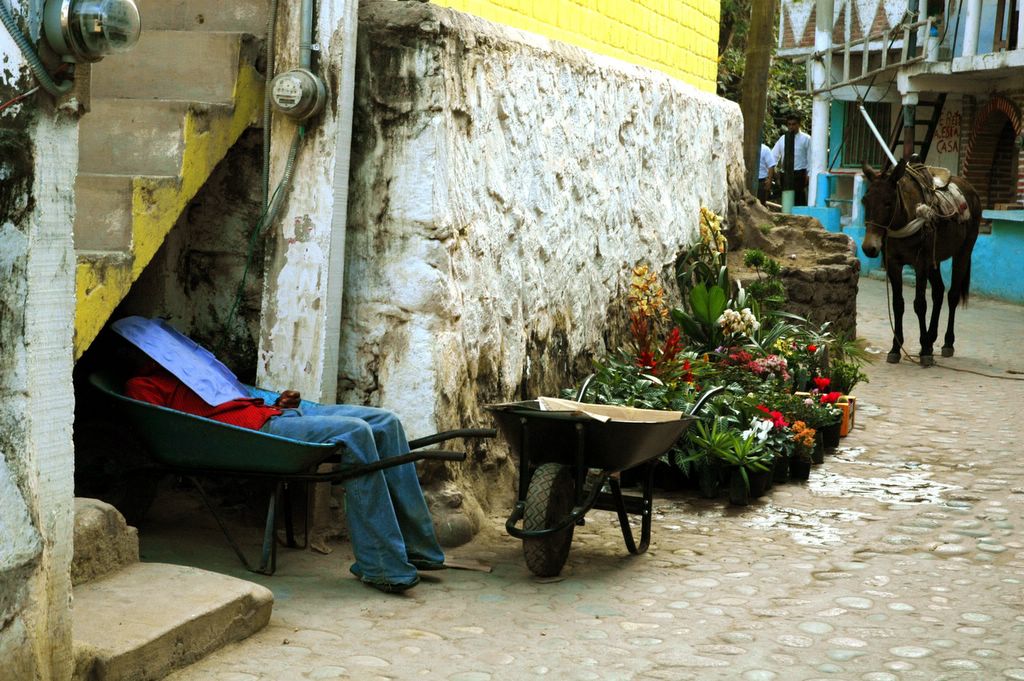
(i thought this picture was fitting; i'm taking a break from my story, and wheelbarrow guy is just plain taking a break.)

andrew david 'siesta' yelapa, mexico.

Tuesday, January 31, 2006

some three-year-old musings on MDD and the movie Magnolia

Thursday, August 08, 2002 – 1:25 AM

I’ve been doing a lot of thinking over the past month and a half but not a lot of writing. In fact, no writing at all, so I figure its about time to get started again. After all, I have to wrack my brain for a travel essay topic and eventually compose twelve artful pages that say something about something. And this is a bad sign. The swirling minutia of irrelevant thoughts that managed to keep me up past midnight suddenly backtracked into nothingness the moment I decided to end my writing fast. Oh, well. Maybe my thoughts will return eventually. In the interim, as I listen to jars of clay and Switchfoot, here’s a movie review of sorts; after all, in the old days, when I actually managed to keep a diary, I included everything from movie reviews to silly lists of what I consumed that day (trix, cinnabon, chocolate-chip-oatmeal cookies, three fruit snacks, a piece of pizza, a third of a donut, and a piece of gum).

Magnolia: A bizarre movie that intermittently follows the lives of twelve very different people, pulling their lives from pure randomness to an intricate web of interconnectedness. At its heart this movie seems to be searching for something to explain the strange coincidences that commingle to form our lives. Falling frogs and ironic deaths also accentuate the movie’s strange taste in storytelling. While I could easily add some plot summary or interesting observations, there’s a reason this movie, which I watched about three weeks ago, popped into my head, and at the moment—and what a brief moment it shall be, because while david gray may be able to bob his head tirelessly to babylon, its putting me to sleep—I want to talk about me. So, as I turned my massive (yet insignificant) to do list over in my mind, pending emails shot to the forefront. One such email will be addressed to Pam; among other things, this email will have to explain why I sometimes feel ‘sick of myself.’ As I was considering this, I stumbled upon the issue of me being or not being depressed (and likewise, this spawned parallel thoughts concerning Sarah and Marianne, but I have only so much space and even less time). Wow, this is gonna’ take forever. So here’s the connection to magnolia. At one point in the movie william h macy (the reason I checked the movie out from the library in the first place) says something like “I’m not depressed, I’m melancholy. There’s a difference.” And he’s right. Lately, however, I haven’t really been feeling either. That’s good news. Thanks Jesus. Goodnight.

1/31/06 post-script:
i still think fondly of that disturbing magnolia movie. i have several friends that live in magnolia. i don't know if they're depressed, but i feel fine. well, mostly fine; the wind keeps waking the motion-sensored light outside my bedroom window, so i've been posting messages to the ESL chat rooms (as, you guessed it, the17pointscale), hoping that talk of em dashes might put me to sleep. in any case, i like the idea of listing my meals for the day--it was ahead of its time. oatmeal, ritz crackers, vanilla wafers, bacon and egg scramble, milk...

Sunday, October 02, 2005

on blogging and boring essays

As the GRE approaches, I will periodically post my embarrassing attempts at timed essays. While I really want you to read my blog --

this is an odd desire that i don't quite understand. in fact, i'm a bit surprised that i even wound up with a blog. unlike some bloggers, i don't particularly like recounting the adventures (ie minutia) of my week. nor is my life so topsy-truvy that i crave a daily flurry of keystrokes to keep me sane (ie i'm not a cathartiholic). and i certainly have no pet issues on which to collect links, provide counsel, or solicit opinions (though i appear to like talking about aesthetics and grammar). in fact, the lack of a passionate message has been the bane of my writing career (ie lack thereof). for example, when queried, 'why don't you consider becoming a writer,' i could respond 'and who would pay me to write? would you pay me to write? no. so how would i survive?' but being the consumate nice guy, i generally choose something a little less vindictive (and more true) like: 'because i don't have anything to say. i (am beginning to) understand the mechanics of writing, but i have no particular passion. i could write a short story, but there'd be no 'deep' underlieing point.' soooo. i tend to lack the imaginative capacity for the subtle nuances that make literature meaningful. dar. and that, strange as it may seem, is perhaps why blogging appeals to me. i can say a bunch of little things with no expectation of a higher purpose.

-- i don't recommend reading these unless you are very, very, very bored and need a pick-me-up to feel better about your own writing. to underscore the fact that i don't recommend reading these essays, they shall be in the tiniest of print.

so why post them at all? i don't know. i think because today i thought it would be quicker to post someting that i'd already written than waste study time blogging (i was wrong). and perhaps someone will read an essay and think 'wow, that gre topic is intriguing. i should take the gre!' or better yet 'how interesting, i should share my opinion on this topic...'

ya'er.


ANDREWS 45 MINUTE ESSAY #1

The perceived chasm between intellectuals and the real, more practical world of everyday life has been the subject of controversy for generations. Naysayers of collegiate education have frequently scoffed at academicians in their ivory towers, insisting that the literati should gain experience in the public workplace before instructing students. However, while this reasoning may seem attractive, it possesses a number of serious flaws.

Perhaps the most prohibitive factor for this philosophy is its impracticality. If universities were to adopt this philosophy, faculty would have to settle a number of challenging questions about how much 'real world' experience would be necessary -- a week, a month, a year, etc, etc. Once this subjective issue was decided, collegiate educators would then need liasons to help arrange temporary positions in the outside community. In addition to being a potentially frustrating experience for the professors, this process would also be a decidedly inconvenient proposition for the businesses.

Another crucial difficutly in assigning professors to 'real world' positions is the problem of determining what occupations might be most relevant. For many humanities subjects there is no direct correlation between subject matter and 'real worldl' positions. For example, literature and philosophy professors tend to teach valuable material that discusses the human condition but provides no concrete link to real world positions. These professors might be at loss for finding 'real world' training that matches their teaching interests.

Another important reason for dismissing this theory is that it suggests a false premise: that 'real world' experience will make better teachers. On the contrary, most professors learn the 'nuts and bolts' to their trade in academic settings. While in University, they are taught both material and the best methods of relaying that material. Hands-on, classroom experience then serves to augment these skills. Forced work in the 'real world' could dull these skills and lessen professors' effectiveness. Moreover, if a professor's passion is for teaching, it seems unwise to force them to work in other settings. This could persuade potential professors from pursuing their teaching dream.

Ultimately, professors belong in the classroom. Manditory 'real world' experience for college faculties would be impractical. In fact, many programs lack a real world corrolary for their professors. Therefore, the best use of their time and talents is teaching students, not learning life lessons in the 'real world.'