Showing posts with label the road. Show all posts

Thursday, December 03, 2009

andrew versus evil foes of mccarthy's the road, part IV

please see "andrew versus evil foes of mccarthy's the road, part I" for a full introduction to my defense of the road, including a chat with evil person on facebook #1, wherein i conclusively demonstrate that the road's lack of quotation marks is perhaps a good thing. and see part I for a chat with evil person on facebook #2, wherein i conclusively demonstrate that the horror of the road is not something to avoid on the basis of fear or morality, and part III, wherein i conclusively demonstrate to evil person facebook #3 that to whatever degree the road is repetitive, that is actually a good thing.

xoxoxoxoxoxo

abbreviated introduction: when a friend posted a facebook comment that challenged the magnificence of cormac mccarthy's the road--which is now playing in a movie theater near you!--i couldn't help but respond. the following defense is adapted from that conversation. where necessary, i have taken the liberty of modifying the arguments of those who would dare question the road into straw-men caricatures of their former selves so that they are more easily vanquished.

evil person on facebook #3: [enters room with his arms outstretched, shouting to all who will listen] my children, my children. i tell you the truth, dark tomes have rained down on us in these last days, black books sent down by oprah herself, books that tell of a coming doom, books that preach a relentless gospel of death, destruction, apocalypse. guard your hearts, steal your souls, arm your children--there is no redemption here; there is no light, no sign of hope. nothing but ash, ash, ash. oh, orphans of mother earth--

andrew, self-appointed defender of the road: hi, there.

evil person on facebook #3: oh, hi.

andrew, self-appointed defender of the road: so, you have some kind of a problem with the road?

evil person on facebook #3: right, like i was saying, a great darkness has settled on the pages of the earth, casting unnatural shadows, as from some ominous pit of doom, some demon lair, some hopeless cavern of death and ash--ash everywhere--and in those three letters there is no redemption, no hope; there is--

andrew, self-appointed defender of the road: OK, stop, stop. i get that the road is dark, but don't you think there's at least a glimmer of hope there? something besides depressing darkness?

evil person on facebook #3: if by hope, you're referring to the final scene of the book. don't even get me started on how that one scene in no way redeems the horror of the entire work. this book, this road, is the cackling buzzard-breath of the apocalypse, it's the four horsemen and their--

andrew, self-appointed defender of the road: oh, please don't. i won't try to convince you that the last little bit redeems the whole--i don't think there's a happy hollywood ending tacked on to the end--but i might be foolish enough to contend that the entire ash-strewn monstrosity is in some ways redeeming. i might be crazy enough to suggest that it walks a road that's both tragedy and comedy, darkness and light, and that when we drag ourselves to the end, we find something that both redeems and leaves us cold and alone.

evil person on facebook #3: that makes two of us crazies then.

andrew, self-appointed defender of the road: i really think that the relationship between the man and the son--which, incidentally, seems like one of the more moving father-son relationships i've ever read--and the son and the earth, offers redemption. perhaps the goodness and light that the boy brings is bounded by time and evil, perhaps whatever good he accomplishes, however long he survives, is a pittance in a larger story of doom. perhaps the fire he carries is ultimately revealed as absurd, but as the book's title suggests, i think the story we see is properly confined to what we read in the text, not some heated guesswork of how the road views humanity's overall death or suvival. and this story is the incarnation--into great darkness is born a child of innocence and light, a child that inexplicably gives of himself in a culture that's way beyond fending for oneself.

andrew, the 17 point scale blogger: [jumping into the conversation with a quick whispered plug] yes, you said the very same thing a few years ago in a book blurb for image update and right here on this blog!

evil person on facebook #3: i don't know what you've done, but--wow!--i'm starting to feel all warm and fuzzy about the road.

Monday, November 30, 2009

andrew versus evil foes of mccarthy's the road, part III

please see "andrew versus evil foes of mccarthy's the road, part I" for a full introduction to my defense of the road, including a chat with evil person on facebook #1, wherein i conclusively demonstrate that the road's lack of quotation marks is perhaps a good thing. and see part II for a chat with evil person on facebook #2, wherein i conclusively demonstrate that the horror of the road is not something to avoid on the basis of fear or morality.

xoxoxoxoxoxo

abbreviated introduction: when a friend posted a facebook comment that challenged the magnificence of cormac mccarthy's the road--which is now playing in a movie theater near you!--i couldn't help but respond. the following defense is adapted from that conversation. where necessary, i have taken the liberty of modifying the arguments of those who would dare question the road into straw-men caricatures of their former selves so that they are more easily vanquished.

evil person on facebook #3: [watches as evil person on facebook #2 stares up into a non-existent sky, says a few words, and leaves the room; then, a moment later, continues watching as person on facebook #2 walks into the room, looks up in a peaceful, hippie-kind of way, speaks, and then walks out; and then he turns to andrew, about to speak, when person on facebook #2 again enters the room, looks up, offers a words to the room, and exits] it's monotonous. it's as if the plot and dialogue keeps repeating itself

andrew, self-appointed defender of the road: i think she's stuck in some kind of an online time loop. let me see if i can adjust the RSS feed settings--

evil person on facebook #3: no, not her. the road! there's all this ash, and then they can't find food, so the man says to the boy, "OK?" and he replies, "OK." and then there's more ash, and then they still can't find, so again the man says to the boy, "OK?" and he replies, "OK."

andrew, self-appointed defender of the road: well, that seems like a gross oversimplification of the plot. they also have all kinds of encounters with ***OMITTED FOR IMPROPER SPOILER USE*** and ***OMITTED FOR IMPROPER SPOILER USE***. they experience emotional highs and lows; they see all kinds of sites. to say that nothing happens in the road seems altogether false. a mountain of more interesting stuff happens to the man and boy then happens to me in any given year. and, what's more, all those empty, forgotten spaces they explore--each and every one holds a mystery. what happened to these people? did they survive? are our brave heroes about to bump into them on the next page?

evil person on facebook #3: OK, but you get my meaning. there's the same feel to the scenes. it seems like he could have just written one chapter and then wrote something that said, "now read this chapter ten more times."

andrew, self-appointed defender of the road: i guess i can't fire any objective responses back at your criticism of the road's pacing. i can only say that the very thing that bothered you is what makes me celebrate mccarthy. the plot of the road (and the border trilogy and perhaps blood meridian, and even the orchard keeper if the first few pages are any indication) is that a few guys walk down a road (or perhaps they ride horses) and violent (or occasionally generous) stuff happens to them, sometimes the same stuff over and over again. it's life. that's what it would be like to haunt a postapocalypse like the one mccarthy has created. and the way the characters speak? that's what it's really like sometimes in my life, so i can only imagine that when things get serious, like in the road, it seems more than likely that all kinds of verbal communication would be stripped away.

[evil person on facebook #2 enters the room and then leaves for good]

and to me, mccarthy makes this interesting and real in a way that i almost don't want anything else to happen. he seems a master of the quiet and the storm. and in the road, there's just so much tension in the environment that to me it didn't matter if nothing or the same thing happened, because mccarthy created a world where i was always thinking of what could happen next.

Friday, November 27, 2009

andrew versus evil foes of mccarthy's the road, part II

please see "andrew versus evil foes of mccarthy's the road, part I" for a full introduction to my defense of the road, including a chat with evil person on facebook #1, wherein i conclusively demonstrate that the road's lack of quotation marks is perhaps a good thing.

xoxoxoxoxoxo

abbreviated introduction: when a friend posted a facebook comment that challenged the magnificence of cormac mccarthy's the road--which is being released this week to a theater near you!--i couldn't help but respond. the following defense is adapted from that conversation. where necessary, i have taken the liberty of modifying the arguments of those who would dare question the road into straw-men caricatures of their former selves so that they are more easily vanquished.

person on facebook #2: [holding back a sob as she watches evil person on facebook #1 happily prance out of the room with a copy of the road held tightly to her chest] oh, my. i just can't--

andrew, self-appointed defender of the road: [handing person on facebook #2 a tissue] what's wrong?

person on facebook #2: [wiping a tear] it's this book. the prose is beautiful, but it's so gruesome. i can't get the images out of my head. i can't sleep--

andrew, self-appointed defender of the road: [with an understanding nod] the road is something of a nightmare. i think you have a valid subjective objection.

[someone in the room snickers at this faux-academic, robotic sounding attempt at empathy]

person on facebook #2: [turns evil]

andrew, self-appointed defender of the road: errr...person on facebook #2? are you OK?

evil person on facebook #2: [laughs maniacally] so i get something like a free pass, then? i may universally dismiss the road and all other literature that disturbs? after all, the beauty of the road would be so much greater if it weren't spoiled by the violence and cruelty and b-l-o-o-o-o-d--

andrew, self-appointed defender of the road: [backing away ever so slightly] well, given that the road is causing you emotional stress and prohibiting you from sleeping at night, then, yes, you might want to stay away. but i don't think it's a good habit to universally avoid things that disturb, that make us consider the darker side of ourselves. many people read books to get away from reality, to escape. that's perhaps why the sale of romances and sci-fi books is recession proof whereas literary fiction is gasping for a profit. but i don't think this is necessarily healthy. in fact, i think that good art, books like the road, depict violence and horror. they may be profane. they may be explicit. they challenge us, make us think, force us to question ourselves and how we perceive our neighbors, even scare us. and the fact, that mccarthy's images stay with you is simply a testament to his talent as a writer. the road should stay with you...

[the smoke from some psychadelic pipe begins to fill the room, obscuring the walls and features of the room. the floor slips away, and it is as if the self-appointed defender of the road and the evil person on facebook #2 are floating in space, surrounded only by rising, ever-widening rings of remembrance]

evil person on facebook #2: gnarly!

andrew, self-appointed defender of the road: for weeks, months, i suppose years, after i first read the road i couldn't stop thinking about where i fit into this shadowy humanity. i'd be in church--

[out of nowhere, a church appears in the distance, floating statically above them, its cross pulsating with bright green light]

--and pastor richard's sermon would trigger some thought of the road. or i'd be scoping out the nasty lunch options at work--

[the cross blinks once more, and then is gone, replaced by filipinos in hairnets and a line of vietnam vets, shifting from foot to foot as they wait for the caregiver's special, a mysterious meat dish, at the VA cafeteria]

--and remember how the man and the boy would celebrate over a rotten apple, a can of soup. this, the way mccarthy's images are seared into your mind, is what i love about the road.

Tuesday, November 24, 2009

andrew versus evil foes of mccarthy's the road, part I

in my last 17 point scale post, i described the evolution of andrew the counterintuitive apologetic. i portrayed myself as a noble knight of truth, dashing about the interweb correcting false impressions, even when the matter at hand was of no relevance to or even contrary to my own beliefs. i examined how these magnanimous traits led me (though perhaps circuitously) to publish a book that looks at atheism from a completely new perspective, that of the christian who seeks to dialogue with atheism rather than destroy atheism, the christian who seeks to learn rather than obliterate.

you should buy that book, "god is dead" and i don't feel so good myself
, and while you're at it, this one too--jesus girls: true tales of growing up female and evangelical! but now i'd like to introduce a bit of realism to that perspective.

i really do see myself as someone who questions positions from all sides of the fence, who in trying to stay objective, often finds himself at odds with people on every side. but that doesn't mean i'm coming from position nowhere, that i only fight for issues where i function as a blank slate. no, i'm also quite happy to play the apologetic for those things that i love.

and so, when a friend posted a facebook comment that challenged the magnificence of cormac mccarthy's
the road--which is being released this week to a theater near you!--i couldn't help but respond. the following defense is adapted from that conversation. where necessary, i have taken the liberty of modifying the arguments of those who would dare question the road into straw-men caricatures of their former selves so that they are more easily vanquished.

evil person on facebook #1: [storms into the room brandishing strunk's elements of style like a sword] how can i read this drivel? [stabbing at an imaginary copy of our beloved pulitzer-prize winner] there's no punctuation. there are no semicolons, hardly ever a colon, and no quotation marks in sight. how am i supposed to know who's talking?

andrew, self-appointed defender of the road: [nodding judiciously] yes, i can understand your frustration. mccarthy's punctuation style can be off-putting. and at first it may take a bit of work to negotiate who says what or even who says what when. but perhaps that extra dose of concentration is actually a good thing.

[
backing away from the sharp edges of strunk and white] i'm actually rather curious if, back when mccarthy was poor, his editor, albert erskine, ever pointed this out to him, ever said, "you know, cormac, there's these things called quotation marks, and if you use them, more readers might buy your book."

but i doubt it--it's really not that unique. lots of literary writers dispense with quotation marks and the like. last month, for example, i read
all the living by c. e. morgan, a young writer on the national book foundation's shortlist for important upcoming authors, and she framed her dialogue in exactly the same way.

cormac mccarthy: [sitting in the corner, legs crossed, speaking to oprah via wikipedia about how, "I] prefer declarative sentences.

evil person on facebook #1: wait, who's that? where did he come from?

andrew, self-appointed defender of the road: oh, don't worry, that's cormac. he usually doesn't like speaking to us literary types, but hold on, i think he's saying something about how he shuns quotation marks and the like because he sees no reason to--

cormac mccarthy: --block the page up with weird little marks.

[
cormac fades back into the internet]

andrew, self-appointed defender of the road: [turning back to the bewildered evil thinker] it may seem strange to sacrifice some measure of readability for the sake of aesthetics, but i really think there's something to cormac's claim. limiting punctuation really does in some minute sense put our focus back on the words, on what's really beings said. perhaps there's something more authentic about it, just like when, in the border trilogy, mccarthy slips into spanish. i can't read more than three words of spanish, and so i might miss out on some sense of what's really happening, but it's more real.

andrew, the 17 point scale blogger: [jumping into the conversation with a quick whispered plug] junot diaz, who we reviewed earlier this month on the blog, does the exact same thing with spanish in his pulitzer-prize winning first novel, the brief wondrous life of oscar wao.

andrew, self-appointed defender of the road: thanks, andrew. [now speaking in his best historian voice] and at least in our current age, i think most writers and editors, the elites who in some way or another, at least until the digital age changes publishing as we know it, decide what we experience as writing, agree. we've entered a period--not a quotation mark!--of what's known as down-style, a time where nearly every style guide encourages the limited use of commas, a time where hilarious websites like http://www.unnecessaryquotes.com/ make fun of the over and incorrect use of scare quotes. and so i guess all i can say is that if you want to read literary writing--i.e., good writing--you'd best get used to it.


stay tuned for parts II, III, and IV.

Friday, November 16, 2007

the road: casting call

in case you haven't heard, cormac mccarthy's postapocalyptic masterpiece, the road, has been gobbled up by hollywood. producer nick wechsler and director john hillcoat have signed on, and the online buzz links either viggo mortenson or guy pearce to the role of the father. but who will play the son?

how about a seattlite? or even better, a greenwoodite! it's possible--the s.o. did some craig's list snooping recently and found this surprising nugget: a greenwood casting agency is "seeking Caucasian Boys, ages 7-10, with a thin build . . . to audition for a lead role opposite Viggo Mortenson . . . for the Feature Film, 'The Road' [sic, sic, sic]."

see: http://seattle.craigslist.org/see/tfr/457653687.html


andrew david. "homage to violence and light" somewhere in alaska.
i selected this photograph because i couldn't find any photos of dark, desolate roads or emaciated father-son scavengers in my portfolio, and fire plays a very, very, very important role in the book.

Thursday, December 14, 2006

the road (continued)

i'm not sure how much i can trust my statcounter, but it appears that some of you are afraid to click on the imageupdate link (or any link for that matter). therefore, i've decided to include the blurb here. there's a chance that the managing editor of imageupdate may force me to remove it, so read quickly--it may disappear at any moment:

Nothing says “Merry Christmas” quite like Cormac McCarthy’s latest novel, The Road. And we mean that. The Road offers a dark, apocalyptic vision of the future, of a charred, useless land, wasted by an unnamed catastrophe and “peopled with refugees [in] masks and goggles, sitting in their rags by the side of the road like ruined aviators.” McCarthy’s characteristically spare dialogue forges a world that is chilling and austere. And into this “crushing black vacuum of the universe” he thrusts a frightened father and son. They push a battered shopping cart south through the ash-choked air, hoping to escape the winter cold, hoping to find food. In this desolation, language and meaning deteriorate, “the names of things slowly following those things into oblivion… the names of things one believed to be true.” The father walks the road with a pistol tucked in his belt—in this savage land, he is no longer free to do right, only to stay alive. But there may be hope in McCarthy’s darkness, perhaps even a sense of the Incarnation, an inkling of Advent. Despite the desperation of their journey, the son walks in empathy. With an innocence foreign to the blighted earth, this boy cares passionately about right and wrong. At times the father “raise[s] his weeping eyes” to see his son “standing there in the road looking back at him from some unimaginable future, glowing in that waste like a tabernacle.” This child, born into a world gone mad, shines with some greater fire. And that’s what Christmas is all about, Charlie Brown (David par. 2).

Wednesday, December 13, 2006

the road

ah, yes. i'm proud to report that i've published yet another blurb in imageupdate.* and in some respects, the paragraph is even a bit christmasy! if nothing else it's one of a kind; when i googled "advent" or "christmas" in conjunction with cormac mccarthy's recently published the road, i got fewer than one relevant hit. perhaps that's because the road is the darkest, most harrowing book that i've read in the last year. perhaps that's because the only mention of christmas in the novel is when the main character points to a fireplace mantle and shows his son a patchwork of pinholes, explaining that holiday stockings once hung from those holes. in any case, read the road. it's worth the tears. and if nothing else, you can look forward to arguing with me about the presence of a christ-child in mccarthy's post-apocalypse.


andrew david. "the road" mt baker, wa.

(actually, imagine the photo as wayyy more dreary. the picture was taken right outside the lodge that i stayed at during bethany community church's wilderness retreat, and, when in color, it is rather beautiful, so it was rather tough to drain it of it's splendor. just imagine that everything in the photo is dying and covered in ash.)

*the final version will be uploaded thursday morning

Monday, December 11, 2006

what i did tonight

this evening i stayed at home. and wrote a blurb for imageupdate. it was for cormac mccarthy's the road. you should read it. reading the road is kind of like walking in the darkness toward a light, but mostly it's just like walking in the darkness. i want to talk to someone about it. read it.

unfortunately, i didn't do any thinking about christmas gifts. i have to do that soon. really soon. too soon.

andrew david. "be careful, mark! you're walking in the post-apocalypse!" seattle, wa.

Monday, December 04, 2006

getting burned

i'd really love for this blog to be a space where i sit at my keyboard and spin fantastic webs of light. i'd love for my words to jump off the page and rattle around in some fellow's brain until they bust a hole in his ventromedial prefrontal cortex, short-circuiting his laissez-faire let-it-be morality, shaking him from his apathy, making him high with the possibility of some greater purpose. but i'm neither prophet nor poet. i'm the anti-dillard--i fill space with preposterous commentary, not meaningful echoes of the sublime. truth is a dreamy-eyed hermit who visits me in secret; she rummages through my cupboards, raids the fridge, and occasionally i catch sight of her coat as she runs through the backyard grass and into the trees. yes, these posts are mostly about grammar, sports, and cooking, but perhaps one day i'll stumble upon her yellow plastic hood bobbing in the rain. until then, i'll be that guy with a holeless brain.

(this itsy-bitsy paragraph was loosely inspired by two burned fingers, a few months of richard dahlstrom's preaching, the blue road, and the book of hebrews...i'd say more about that, but i only have one and a half hands to type.)

andrew david. "imagine these yahoos in christmas sweaters--are we sure we want to go caroling?" shekinah, saskatchewan.

Sunday, November 26, 2006

all full of turkey and nowhere to go?

hi, everyone. i'm finally back from thanksgiving festivities in salem, portland, and poulsbo. during the lonely drive to and from oregon, i had several thoughts that might make it onto the 17 point scale, but most of the miles were spent contemplating song lyrics and the two books that i'm reading, blue like jazz and the road (collectively known as the blue road).

i'm glad to say that the blue road has propelled me back into my normal literary state of andrewdom. let me explain. i'm fairly laid-back about most things; i may grimace at a loathsome vegetable or blast the evil howard schultz, but generally speaking i don't really get passionate about particulars. and it's the same with books: i tend to enjoy most reads. in fact, for most of my life i have identified my favorite book as whatever novel i'm currently reading. i'm fickle; i love the latest fling. but during the last year i've fell prey to a snobby disdain and distance from most authors. david james duncan's the brothers k has remained my top dawg for more than a year, and (despite the fact that tbk is a masterpiece) this kind of embarrasses me. so, in celebration of some new favorites, i've decided to expand the rating links (look to your left) in a full-blown blog post.

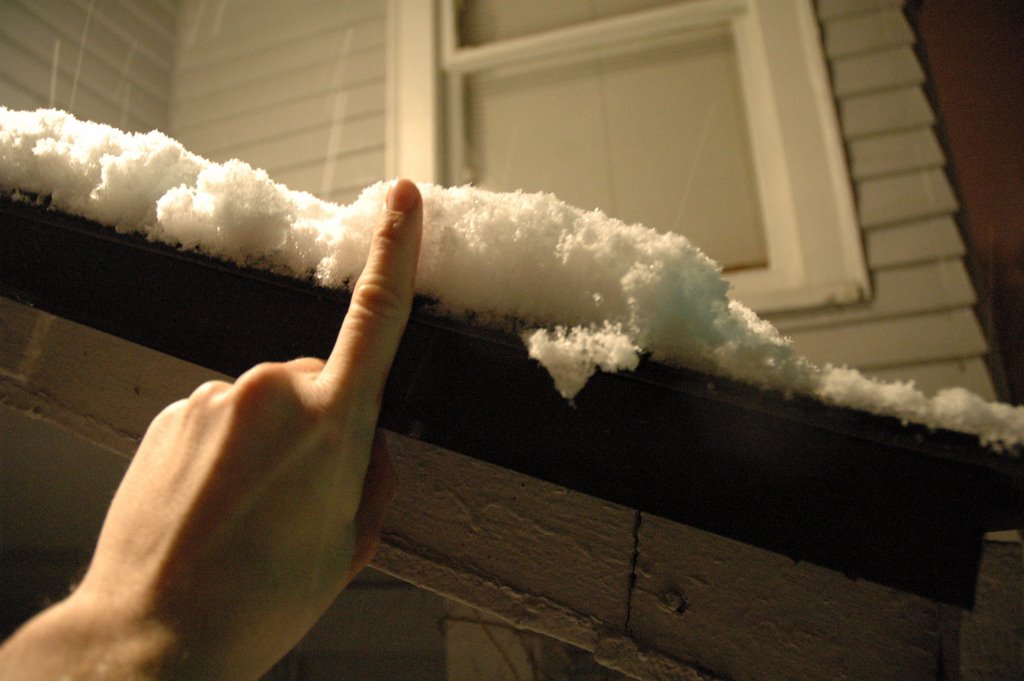
however, my parents dial-up connection prohibited me from any kind of work on the blog-front. and then, upon arriving home, i discovered a strange white powder covering the ground outside my house. after deliberating with my roommate, i decided that the mysterious white required further attention. so, as usual, i'm not going to say much of anything tonight. still, perhaps i'll be back soon. perhaps the snow will shutdown the city, and on monday i'll have nothing to do but blog.

andrew david "2.2 inches, under my window" seattle, washington.
mark tomato "abnormally clad snow dancers" seattle, washington.