Showing posts with label books. Show all posts

Sunday, March 25, 2012

my notes and highlights from brian doyle's novel mink river

...........
A town not big not small. In the hills in Oregon on the coast. Bounded by four waters: one muscular river, two shy little creeks, one ocean. End of May—the first salmonberries are just ripe.
Note: the first "complete" sentence strikes after three periods. poet or novelist?
...........
stunningtownwise—there

...........
if it fermented or a mouse died in it or what.
Note: ok so fragmenty + made-up words + negative examples that push further and further into their own imaginary hypothetical worlds + a dark humor and a flare for image.
...........
the oldest of which finally collapses on page 141.
Note: check this later.
...........
like to paint for inchoate inarticulate unconscious reasons they can’t explain.
Note: oh to be a geometrist of perspective or a painter in touch with his intuitive side
...........
shafts

...........
sheer jungle energy of trees and plants here,
Note: one of the reviewers mentioned the books love affair with adjectives and that reviewer could be right--do we really need "sheer" here?
...........
but don’t get all fascist and linear and anal like highways do;
Note: though you did mention intersections and angles
...........
or the black bear who wandered through the recycling shed at the Department of Public Works and tore apart a pile of newspapers and was discovered reading the New York Times travel section, turning the pages daintily with her claws as big and sharp as steak knives.
Note: awesome
...........
look up, right over there, see the eagle flying low and fast down Curlew Street? Watch: as he sails over the grocery store he whirls and snatches a whirling piece of cardboard, and he flapflopflaps down the street triumphantly, big as a tent, you can almost hear him thinking I am one bad-ass flying machine, this weird flat brown bird didn’t get away from me, no sir, nothing can elude my lightning deftness in the air …
Note: i'm not sure about this book yet, but i do like that eagle...
...........
that no rumpled sheets will tell tales of their vigorous unclothedness;
Note: so the lack of commas in this list is meant to give it a similar vigor? to passively apologize for your use of semicolons?
...........
and so many more stories, all changing by the minute, all swirling and braiding and weaving and spinning and stitching themselves one to another and to the stories of creatures in that place, both the quick sharp-eyed ones and the rooted green ones and the ones underground and the ones too small to see, and to stories that used to be here, and still are here in ways that you can sense sometimes if you listen with your belly, and the first green shoots of stories that will be told in years to come—so many stories braided and woven and interstitched and leading one to another like spider strands or synapses or creeks that you could listen patiently for a hundred years and never hardly catch more than shards and shreds of the incalculable ocean of stories just in this one town, not big, not small, bounded by four waters, in the hills, by the coast, end of May, first salmonberries just ripe.
Note: there are so many stories
...........
capacious shadow
Note: he likes to stick with the same words. repetition is his game. also. eagle!
...........
The two men are drinking beer and eating salmonberries.
Note: of course they are
...........
publicworked
Note: nice. ok, ill shut up soon.
...........
You were going on interminably one day about how one way to defeat Time is by recording every story possible. Not only from people but from everything living.
Note: something tells me this is the theme of the book...
...........
holding on to his line of talk like a rope,
Note: lame
...........
I mean, really, to preserve history, collect stories, repair marriages, prevent crime, augment economic status, promote chess, manage insect populations, run sports leagues, isn’t that a bit much? We even give haircuts.
Note: i love your department!
...........
We have brains that still work so we have to apply them to pain.
Note: the moral imperative
...........
To speak to her honestly about her behavior is to care about her, Billy.
Note: love = honesty?
...........
This is me, Worried Man, making a tape for my grandson Daniel,
Note: draculalike use of multiple mediums
...........
fat half-ton animal is no easy matter, as you can imagine.
Note: ha-some description of horse stealing
...........
Mink River.
Note: first eponymn
...........
defeat it for a while. Which we did for a while.
Note: on "learning" to make love
...........
Her eyes are brown and green and when she is angry the green parts of her eyes flash like fish leaping in a river.
Note: someone who rated the book a one offered this as an example of ridiculously bad writing. i can't decide whether it's good, atrocious, or neither.
...........
boneheadery and lazitude and punishness and detentionery.
Note: i like these words but i doubt the teacher thinks in these words
...........
Green fish are leaping furiously in her eyes.

...........
He makes friends easily because he likes to listen and he is almost always cheerful, even with girls. He thinks about girls all the time. He likes to ride his bike in the woods as fast as he can go.

...........
out that her boyfriend is a liar in about three weeks.
Note: ack (and also, thats very stream of c there)
...........
Grace notices that Red Hugh can no longer easily bend over and pick up heavy tools so she patches the tires.
Note: is this repetition really necessary? id omit this paragraph.
...........
because she packed a suitcase two years ago and walked out the door without a word. The suitcase was enormous. It was far too big for her to carry. The sound of it being dragged down the gravel driveway will stay with Grace and her brothers for ever and ever and ever.

...........
the sagging couch in the corner. Apples. Wet clothes. Bread. Crow.
Note: a list! i really like his lists, but i sometimes feel that his rhythm is haphazard, which i dont like.
...........
Owen’s son Daniel recently began a list of the things in this room:
Note: i like daniel.
...........
help, which he did, to the quiet pleasure of his father.
Note: perfect
...........
Cedar
Note: and i love cedar, though wasnt cedar short and old? and does he think this will actually work? physical power stopping physical power...
...........
your daddy has been a capering fox every minute

...........
It began as a talk about carving holes in wood and then spun into holes in people, things missing; or as she said the feeling that something was missing that you’d never had and hadn’t known you didn’t have until suddenly you knew it.
Note: scary holes
...........
Does she pay that much attention to you? Sure
Note: smrt kid
...........
and soon after that we were trading salty kisses in our own language her long hair whirling around us like the salty arms of the salty sea.

...........
Sentence of the day.
Note: wow.
...........
There is no real love without fascination.

...........
[Who are you?]

...........
Moses, who had been taught to speak by a shy nun who found him broken in the mud, is intricately courteous and circumspect; also he has a dry humor and a corvidian cast of mind, as he likes to say, that combine to make his remarks intriguing.
Note: the crow can converse? wh-wh-what?
...........
A new crow is an awkward cake from the bakery of the Lord; all angles and bones, half naked still from the shell, hardly feathered at all.

...........
when she is bent over her desk in the window he floats over from the top of the refrigerator to her desk and says to her pain mud mother. A sentence neither of them ever forgot.
Note: memory is a big theme here.
...........
A man’s hipbones are handles for his woman’s hands.

...........
Is this a nutty family or what?
Note: yes (and good summary)
...........
He loves opera and his favorite opera of all is Puccini’s Tosca, which he knows by heart and plays constantly in the car. She thinks secretly that he will leave her because she is not exciting.
Note: here i think the back and forth works better than with the father-daughter passage a few pages ago, because of the language being parallel--he said... she said...
...........
forty years times a hundred dinners a year adds up to, let’s see, four thousand invitations. Or maybe eight thousand. And not one declined.
Note: i like friendship.
...........
awake for hours with his eyes glinting in the murky dark.
Note: a beautiful sad list about eating.
...........
stop and Daniel flies over the edge of the cliff with his backpack flapping and his braids going in three directions and his mouth open but no sound emerging whatsoever.
Note: ack. well i guess we were given hints that something bad was on the horizon
...........
The darkness dread & drear. Blake.
Note: i wish i knew blake better.
...........
young woman in throbbing pain on the deck is his daughter.
Note: yep
...........
They are sad stories some of them but we are made of joy and woe both.

...........
hair as black as the inside of a dog.
Note: there it is again. i prefer the black as the back of midnight line.
...........
He has never walked on the beach because he believes the roaring ocean is a bear of incomprehensible size.
Note: i love bears.
...........
and about the father who died and when the doctor opened him afterwards they found he’d eaten nothing but bits of skins of potatoes for months, giving all the potatoes to his wife and children.
Note: good or bad decision?
...........
The man who lied in court is kneeling on the beach praying.
Note: i like how he shows the multitude of stories by just showng fragments of this story. i wonder whether these fragments will bloom into more.
...........
The man who beats his son is on his knees by his bed praying.
Note: two "bad" guys praying; one "good" guy praying.
...........
walks with it upright uphill to where the doctor is waiting.
Note: um.
...........
meat in holes.
Note: ah
...........
the salmonberry bushes. The word for salmonberry is eye of spring.
Note: bear language is rad
...........
Let’s have another baby so we can name her Albina.
Note: opportunity...
...........
If you have a true story and some good water you will be all right,

...........
Funny the things you remember: I remember their feet had exactly the same rhythm as the sea.
Note: stories stories stories
...........
Where and what is Neawanaka? Maple Head poses this question to her class. In one page or less explain our position, character, and/or unique properties. Extra cr for imagination. No copying. I’ll give you ten minutes. Ready? Begin. Answers:
Note: good idea
...........
Neawanaka is the muddy fiefdom of two old men who have for many years manipulated county and state public works budget allocations to fund an endless series of foolhardy and very probably criminal enterprises, that’s what my dad says.
Note: that sounds true but theyre rad enterprises
...........
for he is a man of great imagination, and each cigarette during the course of his day has taken on the flavor of the man for whom it is named. For example his first cigarette of the day, which is called Peter, is the foundation for all else to come, raw and headlong and rough and wonderful, and his fourth cigarette of the day is sweet John, gentle and best loved, inhaled peacefully right after lunch, and his seventh of the day is Thomas the Doubter, which he usually smokes late in the afternoon, when he is tired and riven with the pain of his patients, and fully aware, painfully aware, uncomfortably aware, that the specific assigned mission of the twelve apostles themselves, the real men who walked the earth long ago, fishermen and tax collectors and laborers and such, prickly and confused and exhilarated, was to cure and cleanse every disease and every illness, and drive out the demons in the minds of men and women and children, and accept no coin for their belts, nor sandals, nor walking sticks, but to be sheep in the midst of wolves, shrewd as serpents and simple as doves.
Note: note to self or to dana:the next time youre smoking twelve cigarettes, think of the disciples
...........
south.
Note: whats with the geo directions all of a sudden
...........
Judas son of Iscariot. This man purchased a field with the reward of his iniquity. How very many fields have been purchased with blood money through history, mm?
Note: good point.
...........
We are all war stories.

...........
and then he lies awake for hours with his eyes glinting in the murky dark.
Note: again. poor doctor (?)
...........
Red Hugh has needed his stick to walk properly since he was twenty years old and was lost in the mountains for three days and lost both of his fecking big toes to frostbite.
Note: surprise
...........
as he had half expected would happen when he died,
Note: nice
...........
they sing, a kind of a cheerful prayer or chant of musselness and musselhood,

...........
I know you, says Grace. You’re the kid whose dad beats him up.
Note: um...
...........
They say a lot of things that make you laugh if you listen carefully.
Note: like your gfather
...........
lions speaking in a wet brown language he has always known, its words kelp and salt in his mouth, its verbs the whispers of the sea.
Note: beautiful
...........
Declan stares at his battered boat dead on the shore.
Note: everything is so perfectly connected. it may be gimmicky to do the switchwitheachline thing but it al fits together so well and then this. as if the boat and his father red...
...........
and falls asleep.

...........
supplice a tuoi piedi, on my knees I beg for mercy.
Note: wow
...........
te.
Note: the italics are gone
...........
and Owen never tired of playing it.
Note: quite the song
...........
She was as free as anyone ever could be and so she was trapped.

...........
We’re all a step from the abyss, he thinks. One slip and it’s all over. We’re all a car wreck or a disease or a wrenched back or a black funk or a badly hurt child or a bitter divorce away from disaster.

...........
From long bilingual habit he translates silently in his mind sentence by sentence as he goes.
Note: thanks.
...........
.
Note: on rain
...........
On Rachel taking off her shirt with both hands in the deft graceful crosshanded way that women pull their shirts over their heads
Note: i need to see me some of that deft grace
...........
.
Note: list of various perceptions of time.
...........
noon Mass.
Note: a noon mass eh
...........
for each of us, man and woman alike, is a seething sea of desires and shadows, of illusions and dreams, of courage and cowardice, and we arrive in peaceful harbors only by sailing ourselves true, by finding and wielding our talents as tools to help others. In a real sense we arrive home only by leaving the island of I.
Note: we must serve others. nicely homilied.
...........
not knowing quite yet whether or not to take your glasses off when you kiss intensely or where to put your hands exactly or whether to keep your eyes closed all the time or not
Note: whats the answer
...........
eyes locked their loins locked her fingers locked in his hair.
Note: well i guess thats an answer
...........
away that he thinks she doesn’t see him but she does.
Note: whyd he go to church?
...........
Lock the door, she says.
Note: mass leads to sex. hmm...
...........
She desires my joy. I desire her joy. That’s the point of being married. To want the other to be joyfully at peace.
Note: the point of marriage
...........
evil.
Note: not just bad or not well nut evil
...........
sees Rachel flash past as leggy and free as a young deer and Rachel sees Sara as strong and wise as the sea.
Note: ah misperception
...........
I’m not her father or brother or lover. I am no one to her. I’m no one. I have no right. You have to love someone before you can say something searing. Isn’t that right? You have to love people to hurt them. Isn’t that right?
Note: wow. on inflicting pain.
...........
here I am, Kristi. Here I am.
Note: so biblical
...........
One time an old man who used to be a track coach brought a stopwatch to the beach and timed her and did some calculations and then threw his stopwatch into the sea. That really happened.

...........
I wish only to see her again. Her face is now my food.
Note: love
...........
the sound of lost, the sound of empty, the sound of alone.

...........
Part of Sara wants to bolt back up the path
Note: indeed. i would bolt.
...........
of the burly broken mewling world.

...........
These things matter to me,
Note: perhaps i should make this list...
...........
The way that frozen dew outlines every blade of grass. Salmonberries thimbleberries cloudberries snowberries elderberries salalberries gooseberries. My children learning to read.

...........
Book marginalia written with the lightest possible pencil as if the reader is whispering to the writer.
Note: my marginalia is more like screaming
...........
That young guy on the island, Nora, he told me he ran out of bullets and hope on that island. He wanted to die. But he got himself back, Nora. He started again clean. He was born a second time. He used to say that his old self died on one island and his new self was born one island over. I disremember the name of the second island but he used to call it Resurrection Island. He used to wonder if there were lots of resurrection islands. I think maybe there are. I think maybe they are all over the place. I think maybe we don’t even see the half of them.
Note: Cedar on resurrection islands.
...........
end over end a tiny silver bird flying toward the sea.
Note: i did not expect that.
...........
and enters the ancient endless patient ocean, where all stories end, where all stories are born.

...........
and wondered at the wander of her life.

...........
Blake.
Note: blakes back!
...........
There’s a story in everything and the more stories I hear the less sad I am.

...........
Tu tu tu, says Nora, and they howl with laughter, howl so loud that the loon at sea turns to look at what it takes to be two new loons on land.
Note: nice
...........
Cows smell the smoke and do nothing.
Note: ha
...........
Two yellowjacket wasps linger by the grill where shreds of meat adhere until Cedar says something quietly to them in their language and they rise quietly into the air and go home.
Note: he speaks wasp
...........
yellow
Note: not sure why teres so much yellow recently
...........
One thing he has learned in his practice is to hear what his patients don’t say; which is, he has often thought, more telling than their tales. He cuts another pear.
Note: this is interesting in light of the fact that we read a lot of stories or tales inthis book, so its almost as if in this one sentence the doctor offers cause to reread and reconsider all that has preceded this...
...........
They smelled like grandfathers, she said once to her husband, who never forgot anything she said to him, and often turned her remarks this way and that in his mind long afterward, looking at them from different angles, wondering.
Note: rad
...........
Most definitely he is getting into the next county and then he will figure it out from there.
Note: why didnt he already do that then?
...........
Sometimes something changes you forever and often it’s the smallest thing, a thing you wouldn’t think would be able to carry such momentous weight, but it’s like playground teeter-totters, those exquisitely balanced splintery pine planks with a laughing or screaming child at each end, where the slightest change in weight to one end tips everything all the way; and what tipped the doctor into a new life just happened a minute ago.
Note: life can be teetertottery
...........
now; but the doctor stood at the sink like a stone.
Note: not a scene one would necessarily teetertotter one
...........
The guy feels everything on his face, the wild holy world, the salt and the wet wind and the wheel of the birds, the hot sweet fingers of the sun, and then he stops thinking, he loses thought, he sifts down below where thoughts are, the last images in his mind as his lights go dim are his children when they were very small, the squirm and wrestle and tumult of them, the very last picture in his mind is them tumbling on a brilliant wooden floor, and then he’s gone, and Declan is holding what used to be a man.
Note: a death scene
...........
wrestle with each other and then alder totally wins the day.
Note: :)
...........
like a baby asleep under the maternal jaw;
Note: int image tom because jaw somehow sounds ver masculine to me.
...........
Time in its motley colors. It has color as well as speed and pace. Of course there are blue times and gray times, black times and golden times, times of red rage, time with russet edges, etc. Time held me green and dying though I sang in my chains like the sea. Dylan Thomas. Should write this down. Be a great project. Measure color spectra over time duration in coordination with perception of same. Owen can make a machine. Also examine perceived color of time in concert with reported emotional state: nostalgia, sentimentality, melancholy, romance, frustration, etc. Public Work. Imagine the report! Colored filters, film spools. Spoor of time.
Note: Pete and Bendan, look time and color!
...........
what to make of this new liquid noise in the world.
Note: nice
...........
roiling
Note: i think he likes this word.
...........
Sometimes we were ill and hungry and the rain was relentless and I couldn’t see any way we would ever get out. Love doesn’t save anybody.

...........
The Boys, we hated that, the three of us labeled genderically,

...........
Final project, says Maple Head to her class. In the last fifteen minutes of class today, write down some things you believe in that don’t make sense.
Note: Interesting thing to consider?
...........
There are some things about even the people you love the best and deepest that you will never know. That’s just how it

...........
My friend Kristi thinks that our town will become famous for storytelling. She says maybe we will build a storytelling factory and people will come to hear and buy and trade stories and there will be story festivals and contests and etc.
Note: k is wise
...........
Human people, says Moses, think that stories have beginnings and middles and ends, but we crow people know that stories just wander on and on and change form and are reborn again and again.
Note: crows are wise
...........
Because stories keep going and going. They are a sort of food, I think. But what do I know, Owen? I am only an old crow person who used to have wings.

Sunday, January 23, 2011

what i like about my kindle (samples!) part 2

for the past few years, i've been a bystander in the e-reader revolution. i've read a lot about how e-books are going to destroy the publishing industry and i've read a lot about how e-books will be the salvation of the publishing industry. but, of course, the future of publishing is more nuanced than either of those two perspectives, so i've also read a ton (which is like three a lots) about how e-books will be both the death knell and the salvation of the publishing industry. at the same time.

and so, this fall, when my mother asked me for a christmas list, i asked for (and then received) an e-reader. i figured it was finally time to (potentially) throw my parents' two cents into the ring and develop an opinion based on the real thing. enough theory, i thought, let's touch and feel the thing. let's see what it's like to actually read a book using an e-reader.

i just e-read my first book, big machine by victor lavalle, and the kindle reading experience was neither off-putting nor a mesmerizing delight. like any new experience, there were little boring things that i liked (e.g., the ease of reading while my hands are busy, that is, not having to prop the book open to a page) and didn't like (e.g., the difficulty of making in-text notes that include "advanced" punctuation marks like commas, question marks, and smiley faces), but i'm neither tempted to sell my bookcases nor return the kindle. i don't have much else to add on this point.

however, my learning-through-the-generosity-and-consumerism-of-others approach to understanding the effect that e-readers might have on publishing has been a success.

i mentioned in an earlier post that when in sleep mode the kindle displays some kind of an image, often a portrait of an important literary figure or some ancient-looking text. occasionally, the kindle also displays a silhouetted  image of a person, perhaps a child, reading a book under the cover of a single tree. below this image is a definition for kindle--"light or set fire. arouse or inspire"--followed by some examples of the word's use.

i hadn't thought of the product name kindle except as a nonsense word, like nook (although i suppose that too is connected to its parent word, as if the nook provides some kind of a cozy space for reading and learning). but my exploration of the kindle interface gives me hope that it may indeed kindle readership, and in a way that i hadn't imagined.

what i found most interesting and awesome about the kindle, especially for the future of publishing, is the sample feature. it turns out that every kindle book has a sample. i've been using google books and amazon's preview function for awhile now, so perhaps this shouldn't have been so surprising. but nonetheless, reading something on the internet, whether on my laptop or iphone, is so much less cozy than on my e-reader. and the good news is that the samples are fairly lengthy, long enough anyway to give a good sense of the book.

my kindle really is like a portable bookstore. i can download samples (or purchase books) from anywhere there's a cell signal or wi-fi connection, and i can download (or purchase) as many samples (or books) as i like. this means i'm not bound by a visit to a store. a coworker might mention a book to me on monday, and so i download a sample. and then, while walking to my car on thursday, i might read the sample and decide it looks worth a read.

and so, although i'm probably wrong about this, i'm hopeful that the convenience of this sample function could indeed open readers up to all kinds of things they might not otherwise read. it could make people more likely to pick up a new book. i'm a strange bird, but for me it already has. for whatever reason, i've doubled my reading pace since owning a kindle.  

if nothing else, the immediacy and ease of the purchase function should lead to more sales. and as someone who appreciates good books and great writers, who wants publishers to continue finding and publishing good books and great writers, and who imagines a universe where great writers can make a living pursuing their craft and someone like me can make a living helping them do that, that makes me happy. 

hooray for e-readers! hooray for people who spend money on books! hooray for happiness!

Tuesday, January 11, 2011

if i were discussing this novel: big machine

in the last year, i spent a month doing nothing but staring at computer monitors. i spent nine intolerable months plotting the destruction of the very thing i valued most in my life (which was not a computer monitor). and i spent most of my nights in clumsy chase of questions i couldn't ask. i also did some ordinary things, like drive my ford, make soup, and write stupid stuff on the internet. there was enough existential angst in that year to people a squabbling troop of teenagers, enough relationship madness to secure a plot line on days of our lives.

but i don't think my year would have made a good novel, unless, that is, someone like victor lavalle got a hold of my story.

lavalle's big machine is the kind of novel that blends emotional depth and ordinary life with the absurd. he takes a troubled character--an andrew, if you will--and bends him around a series of ever-more shocking circumstances. imagine haruki murakami's the wind-up bird chronicle without the strange sexual fixations and with a more tangible sense of personhood and culture--lavalle's story consciously focuses on particular racial and economic groups (and the protagonist, in his cleverness and humble beginnings, and perhaps, i'll admit it, his non-whiteness, actually reminds me of the narrator of aravind adiga's the white tiger).

big machine is a novel that confronts some of the whys, whats, and hows of my 2010. and in doing so, it sidles right up to the darkness and says, have faith.

xoxoxoxoxox

i'm leaning toward a 13/17 rating, which makes big machine a 17 point scale-recommended title, unless you prefer to avoid titles with profanity, fantastical events, and almost-too-perfect chapter-ending cliff-hangers.

you can purchase big machine here.

Thursday, December 03, 2009

andrew versus evil foes of mccarthy's the road, part IV

please see "andrew versus evil foes of mccarthy's the road, part I" for a full introduction to my defense of the road, including a chat with evil person on facebook #1, wherein i conclusively demonstrate that the road's lack of quotation marks is perhaps a good thing. and see part I for a chat with evil person on facebook #2, wherein i conclusively demonstrate that the horror of the road is not something to avoid on the basis of fear or morality, and part III, wherein i conclusively demonstrate to evil person facebook #3 that to whatever degree the road is repetitive, that is actually a good thing.

xoxoxoxoxoxo

abbreviated introduction: when a friend posted a facebook comment that challenged the magnificence of cormac mccarthy's the road--which is now playing in a movie theater near you!--i couldn't help but respond. the following defense is adapted from that conversation. where necessary, i have taken the liberty of modifying the arguments of those who would dare question the road into straw-men caricatures of their former selves so that they are more easily vanquished.

evil person on facebook #3: [enters room with his arms outstretched, shouting to all who will listen] my children, my children. i tell you the truth, dark tomes have rained down on us in these last days, black books sent down by oprah herself, books that tell of a coming doom, books that preach a relentless gospel of death, destruction, apocalypse. guard your hearts, steal your souls, arm your children--there is no redemption here; there is no light, no sign of hope. nothing but ash, ash, ash. oh, orphans of mother earth--

andrew, self-appointed defender of the road: hi, there.

evil person on facebook #3: oh, hi.

andrew, self-appointed defender of the road: so, you have some kind of a problem with the road?

evil person on facebook #3: right, like i was saying, a great darkness has settled on the pages of the earth, casting unnatural shadows, as from some ominous pit of doom, some demon lair, some hopeless cavern of death and ash--ash everywhere--and in those three letters there is no redemption, no hope; there is--

andrew, self-appointed defender of the road: OK, stop, stop. i get that the road is dark, but don't you think there's at least a glimmer of hope there? something besides depressing darkness?

evil person on facebook #3: if by hope, you're referring to the final scene of the book. don't even get me started on how that one scene in no way redeems the horror of the entire work. this book, this road, is the cackling buzzard-breath of the apocalypse, it's the four horsemen and their--

andrew, self-appointed defender of the road: oh, please don't. i won't try to convince you that the last little bit redeems the whole--i don't think there's a happy hollywood ending tacked on to the end--but i might be foolish enough to contend that the entire ash-strewn monstrosity is in some ways redeeming. i might be crazy enough to suggest that it walks a road that's both tragedy and comedy, darkness and light, and that when we drag ourselves to the end, we find something that both redeems and leaves us cold and alone.

evil person on facebook #3: that makes two of us crazies then.

andrew, self-appointed defender of the road: i really think that the relationship between the man and the son--which, incidentally, seems like one of the more moving father-son relationships i've ever read--and the son and the earth, offers redemption. perhaps the goodness and light that the boy brings is bounded by time and evil, perhaps whatever good he accomplishes, however long he survives, is a pittance in a larger story of doom. perhaps the fire he carries is ultimately revealed as absurd, but as the book's title suggests, i think the story we see is properly confined to what we read in the text, not some heated guesswork of how the road views humanity's overall death or suvival. and this story is the incarnation--into great darkness is born a child of innocence and light, a child that inexplicably gives of himself in a culture that's way beyond fending for oneself.

andrew, the 17 point scale blogger: [jumping into the conversation with a quick whispered plug] yes, you said the very same thing a few years ago in a book blurb for image update and right here on this blog!

evil person on facebook #3: i don't know what you've done, but--wow!--i'm starting to feel all warm and fuzzy about the road.

Monday, November 30, 2009

andrew versus evil foes of mccarthy's the road, part III

please see "andrew versus evil foes of mccarthy's the road, part I" for a full introduction to my defense of the road, including a chat with evil person on facebook #1, wherein i conclusively demonstrate that the road's lack of quotation marks is perhaps a good thing. and see part II for a chat with evil person on facebook #2, wherein i conclusively demonstrate that the horror of the road is not something to avoid on the basis of fear or morality.

xoxoxoxoxoxo

abbreviated introduction: when a friend posted a facebook comment that challenged the magnificence of cormac mccarthy's the road--which is now playing in a movie theater near you!--i couldn't help but respond. the following defense is adapted from that conversation. where necessary, i have taken the liberty of modifying the arguments of those who would dare question the road into straw-men caricatures of their former selves so that they are more easily vanquished.

evil person on facebook #3: [watches as evil person on facebook #2 stares up into a non-existent sky, says a few words, and leaves the room; then, a moment later, continues watching as person on facebook #2 walks into the room, looks up in a peaceful, hippie-kind of way, speaks, and then walks out; and then he turns to andrew, about to speak, when person on facebook #2 again enters the room, looks up, offers a words to the room, and exits] it's monotonous. it's as if the plot and dialogue keeps repeating itself

andrew, self-appointed defender of the road: i think she's stuck in some kind of an online time loop. let me see if i can adjust the RSS feed settings--

evil person on facebook #3: no, not her. the road! there's all this ash, and then they can't find food, so the man says to the boy, "OK?" and he replies, "OK." and then there's more ash, and then they still can't find, so again the man says to the boy, "OK?" and he replies, "OK."

andrew, self-appointed defender of the road: well, that seems like a gross oversimplification of the plot. they also have all kinds of encounters with ***OMITTED FOR IMPROPER SPOILER USE*** and ***OMITTED FOR IMPROPER SPOILER USE***. they experience emotional highs and lows; they see all kinds of sites. to say that nothing happens in the road seems altogether false. a mountain of more interesting stuff happens to the man and boy then happens to me in any given year. and, what's more, all those empty, forgotten spaces they explore--each and every one holds a mystery. what happened to these people? did they survive? are our brave heroes about to bump into them on the next page?

evil person on facebook #3: OK, but you get my meaning. there's the same feel to the scenes. it seems like he could have just written one chapter and then wrote something that said, "now read this chapter ten more times."

andrew, self-appointed defender of the road: i guess i can't fire any objective responses back at your criticism of the road's pacing. i can only say that the very thing that bothered you is what makes me celebrate mccarthy. the plot of the road (and the border trilogy and perhaps blood meridian, and even the orchard keeper if the first few pages are any indication) is that a few guys walk down a road (or perhaps they ride horses) and violent (or occasionally generous) stuff happens to them, sometimes the same stuff over and over again. it's life. that's what it would be like to haunt a postapocalypse like the one mccarthy has created. and the way the characters speak? that's what it's really like sometimes in my life, so i can only imagine that when things get serious, like in the road, it seems more than likely that all kinds of verbal communication would be stripped away.

[evil person on facebook #2 enters the room and then leaves for good]

and to me, mccarthy makes this interesting and real in a way that i almost don't want anything else to happen. he seems a master of the quiet and the storm. and in the road, there's just so much tension in the environment that to me it didn't matter if nothing or the same thing happened, because mccarthy created a world where i was always thinking of what could happen next.

Friday, November 27, 2009

andrew versus evil foes of mccarthy's the road, part II

please see "andrew versus evil foes of mccarthy's the road, part I" for a full introduction to my defense of the road, including a chat with evil person on facebook #1, wherein i conclusively demonstrate that the road's lack of quotation marks is perhaps a good thing.

xoxoxoxoxoxo

abbreviated introduction: when a friend posted a facebook comment that challenged the magnificence of cormac mccarthy's the road--which is being released this week to a theater near you!--i couldn't help but respond. the following defense is adapted from that conversation. where necessary, i have taken the liberty of modifying the arguments of those who would dare question the road into straw-men caricatures of their former selves so that they are more easily vanquished.

person on facebook #2: [holding back a sob as she watches evil person on facebook #1 happily prance out of the room with a copy of the road held tightly to her chest] oh, my. i just can't--

andrew, self-appointed defender of the road: [handing person on facebook #2 a tissue] what's wrong?

person on facebook #2: [wiping a tear] it's this book. the prose is beautiful, but it's so gruesome. i can't get the images out of my head. i can't sleep--

andrew, self-appointed defender of the road: [with an understanding nod] the road is something of a nightmare. i think you have a valid subjective objection.

[someone in the room snickers at this faux-academic, robotic sounding attempt at empathy]

person on facebook #2: [turns evil]

andrew, self-appointed defender of the road: errr...person on facebook #2? are you OK?

evil person on facebook #2: [laughs maniacally] so i get something like a free pass, then? i may universally dismiss the road and all other literature that disturbs? after all, the beauty of the road would be so much greater if it weren't spoiled by the violence and cruelty and b-l-o-o-o-o-d--

andrew, self-appointed defender of the road: [backing away ever so slightly] well, given that the road is causing you emotional stress and prohibiting you from sleeping at night, then, yes, you might want to stay away. but i don't think it's a good habit to universally avoid things that disturb, that make us consider the darker side of ourselves. many people read books to get away from reality, to escape. that's perhaps why the sale of romances and sci-fi books is recession proof whereas literary fiction is gasping for a profit. but i don't think this is necessarily healthy. in fact, i think that good art, books like the road, depict violence and horror. they may be profane. they may be explicit. they challenge us, make us think, force us to question ourselves and how we perceive our neighbors, even scare us. and the fact, that mccarthy's images stay with you is simply a testament to his talent as a writer. the road should stay with you...

[the smoke from some psychadelic pipe begins to fill the room, obscuring the walls and features of the room. the floor slips away, and it is as if the self-appointed defender of the road and the evil person on facebook #2 are floating in space, surrounded only by rising, ever-widening rings of remembrance]

evil person on facebook #2: gnarly!

andrew, self-appointed defender of the road: for weeks, months, i suppose years, after i first read the road i couldn't stop thinking about where i fit into this shadowy humanity. i'd be in church--

[out of nowhere, a church appears in the distance, floating statically above them, its cross pulsating with bright green light]

--and pastor richard's sermon would trigger some thought of the road. or i'd be scoping out the nasty lunch options at work--

[the cross blinks once more, and then is gone, replaced by filipinos in hairnets and a line of vietnam vets, shifting from foot to foot as they wait for the caregiver's special, a mysterious meat dish, at the VA cafeteria]

--and remember how the man and the boy would celebrate over a rotten apple, a can of soup. this, the way mccarthy's images are seared into your mind, is what i love about the road.

Tuesday, November 24, 2009

andrew versus evil foes of mccarthy's the road, part I

in my last 17 point scale post, i described the evolution of andrew the counterintuitive apologetic. i portrayed myself as a noble knight of truth, dashing about the interweb correcting false impressions, even when the matter at hand was of no relevance to or even contrary to my own beliefs. i examined how these magnanimous traits led me (though perhaps circuitously) to publish a book that looks at atheism from a completely new perspective, that of the christian who seeks to dialogue with atheism rather than destroy atheism, the christian who seeks to learn rather than obliterate.

you should buy that book, "god is dead" and i don't feel so good myself
, and while you're at it, this one too--jesus girls: true tales of growing up female and evangelical! but now i'd like to introduce a bit of realism to that perspective.

i really do see myself as someone who questions positions from all sides of the fence, who in trying to stay objective, often finds himself at odds with people on every side. but that doesn't mean i'm coming from position nowhere, that i only fight for issues where i function as a blank slate. no, i'm also quite happy to play the apologetic for those things that i love.

and so, when a friend posted a facebook comment that challenged the magnificence of cormac mccarthy's
the road--which is being released this week to a theater near you!--i couldn't help but respond. the following defense is adapted from that conversation. where necessary, i have taken the liberty of modifying the arguments of those who would dare question the road into straw-men caricatures of their former selves so that they are more easily vanquished.

evil person on facebook #1: [storms into the room brandishing strunk's elements of style like a sword] how can i read this drivel? [stabbing at an imaginary copy of our beloved pulitzer-prize winner] there's no punctuation. there are no semicolons, hardly ever a colon, and no quotation marks in sight. how am i supposed to know who's talking?

andrew, self-appointed defender of the road: [nodding judiciously] yes, i can understand your frustration. mccarthy's punctuation style can be off-putting. and at first it may take a bit of work to negotiate who says what or even who says what when. but perhaps that extra dose of concentration is actually a good thing.

[
backing away from the sharp edges of strunk and white] i'm actually rather curious if, back when mccarthy was poor, his editor, albert erskine, ever pointed this out to him, ever said, "you know, cormac, there's these things called quotation marks, and if you use them, more readers might buy your book."

but i doubt it--it's really not that unique. lots of literary writers dispense with quotation marks and the like. last month, for example, i read
all the living by c. e. morgan, a young writer on the national book foundation's shortlist for important upcoming authors, and she framed her dialogue in exactly the same way.

cormac mccarthy: [sitting in the corner, legs crossed, speaking to oprah via wikipedia about how, "I] prefer declarative sentences.

evil person on facebook #1: wait, who's that? where did he come from?

andrew, self-appointed defender of the road: oh, don't worry, that's cormac. he usually doesn't like speaking to us literary types, but hold on, i think he's saying something about how he shuns quotation marks and the like because he sees no reason to--

cormac mccarthy: --block the page up with weird little marks.

[
cormac fades back into the internet]

andrew, self-appointed defender of the road: [turning back to the bewildered evil thinker] it may seem strange to sacrifice some measure of readability for the sake of aesthetics, but i really think there's something to cormac's claim. limiting punctuation really does in some minute sense put our focus back on the words, on what's really beings said. perhaps there's something more authentic about it, just like when, in the border trilogy, mccarthy slips into spanish. i can't read more than three words of spanish, and so i might miss out on some sense of what's really happening, but it's more real.

andrew, the 17 point scale blogger: [jumping into the conversation with a quick whispered plug] junot diaz, who we reviewed earlier this month on the blog, does the exact same thing with spanish in his pulitzer-prize winning first novel, the brief wondrous life of oscar wao.

andrew, self-appointed defender of the road: thanks, andrew. [now speaking in his best historian voice] and at least in our current age, i think most writers and editors, the elites who in some way or another, at least until the digital age changes publishing as we know it, decide what we experience as writing, agree. we've entered a period--not a quotation mark!--of what's known as down-style, a time where nearly every style guide encourages the limited use of commas, a time where hilarious websites like http://www.unnecessaryquotes.com/ make fun of the over and incorrect use of scare quotes. and so i guess all i can say is that if you want to read literary writing--i.e., good writing--you'd best get used to it.


stay tuned for parts II, III, and IV.

Thursday, November 19, 2009

if i were discussing this book: "god is dead" and i don't feel so good myself

in my transition from the college to post-college life, i responded to the decreasing frequency of late night musings and existential inquiry by instead spilling my thoughts online. strangely enough, the e-place that i most frequently turned to for ravenous debate was englishforums.com, a website where moderators and well-meaning amateurs helped ESL speakers tackle this great monster we call english. and so when i got bored answering grammar riddles, i wandered into the controversial subjects forum.

yet rather than argue for my own causes, i ran to the side of perspectives that seemed, to me, falsely maligned. perhaps because of the vitriolic, one-sided tenor of argument that is a universal fact of the internet, or perhaps because of some innate character flaw, or perhaps because of the empathy-inducing influence of fiction and the gospel, whatever the cause, in between offering advice on commas and prepositions, i ignored my own quest to prove that mormonism wasn't a subset of christianity, for example, to prove that catholicism was (clarification: i'm not catholic).

this tendency for counterintuitive apologetics has, i think, found its way into my real-life character as well. at many a cousin-camping trip, i've stood at the fire, defending catholic theology to my fellow protestants. i campaign for liberal causes among my conservative friends, and conservative causes among my liberal friends.

and now, with the help of my fellow editors, chris keller and jon stanley, i've taken the ultimate crazy step: i've published a book that uses analytic essays, social commentary, poetry, interviews, and art to ask what we christians can learn from atheists. that is, how can christian theology approach atheism, that very concept that seems opposite and anathematic to christianity?"

my intentions are a bit different here--i don't intend to argue that atheists have been misunderstood--but they are related. as we suggest in our introduction, the cultural conversation surrounding new atheism and christianity has become a great swelling of voices, so loud and so self-righteous, that there's no space for quiet, compassionate consideration.

in any case, i encourage you to check out our book,
"god is dead" and i don't feel so good myself: theological engagements with the new atheism, and see what you think.

xoxoxoxoxoxo

this is clearly a 17/17 read! OK, OK, you probably shouldn't trust me. i'm a bit biased by the fifty cent royalty for every thousand or so copies sold. look at the website below to see what brian mclaren says about this "brilliant book," or how james k. a. smith refers to it as a "stunning collection" and an "intellectual feast."

you can purchase and read about
god is dead here (where it's cheaper than at amazon!).

Sunday, November 15, 2009

if i were discussing this book: the brief wondrous life of oscar wao

i'm hesitant to mark my return to the 17 point scale flash-book reviews (pretend that's an n-dash) by examining junot diaz's the brief wondrous life of oscar wao--the book jacket includes quotes from famous publications that pretty much nail my every thought on the book. it's "extraordinarily vibrant" (NYT), "hauntingly horrific" (SFC), "deliciously casual" (TBG), and "achingly personal" (LAT). and even beyond the ubiquity of glowing adverb + adjective constructions for oscar, if you pick out nearly any oscar blurb, i think you'll find me nodding along, "yes, yes. he's right. it is a brilliant multigenerational, globally enacted tragicomedy of sex and nerdom, an epic bildungsroman with voice and pizazz!" (T17PS).

but then i remember the point of this series: i'm not attempting reviews. i'm not even attempting to discuss books in any meaningful way. i merely want to give a sense of what i think of books and what i might say if i were forced to pen a thoughtful essay on said books. it's really quite liberating.

which brings me back to my rather common response to
oscar.

a responsible thinker might question whether books like oscar perpetuate latin american stereotypes in the U.S. psyche (my friend dalia, an IU grad student, reminded me of this, which reminded me of this article about roberto bolano in the guardian). or perhaps he might study the sexual ethics and norms in oscar and then contrast those behaviors with the mind-splitting oppression of the dominican republic under trujillo and his "nazgul" minions; that'd be my second choice.

but my essay would focus on that one trait that seems to have made
oscar a universal sensation, the winner of the pulitzer prize for fiction, the national book critics circle award for fiction, time's #1 fiction book, et cetera: voice.

i'd attempt to locate the book in the context of other works throughout the centuries that have successfully combined a literary style (i.e., poetic language, thoughtful plot, full characters) with a not-so literary (and funny!) idiom. that is, diaz combines a sense of the literary--take this, for a random example, "It went up in a flash, like gasoline, like a stupid hope, and if I hadn’t thrown it [the burning wig] in the sink it would have taken my hand. … That was when she slapped at me, when I struck her hand and she snatched it back, like I was the fire"--with hilarious shout outs to contemporary vernacular. in
oscar we read about the One Ring, about Galactus and the Watchmen. we learn of the protagonist's desire to "combine world-class martial artistry with deadly firearms proficiency" and his sister, who unleashed one of the great Street Fighter chain attacks of all time (OK, as essay on violence could work, too).

and so i wonder what other books of fiction might fit in this canon of works that dare to combine the high and low (?) art to humorous and strangely profound effect.

xoxoxoxoxoxo

i'm leaning toward a 13/17 rating, which makes oscar a 17 point scale recommended title, unless you prefer to avoid titles with copious amounts of violence, profanity, and sex. after all, if you condense this story to the simplicity of its most central device, it really is nothing more than the story of its protagonist's quest to lose his virginity.

you can purchase oscar here.

i'm also tweeting cool passages from the book at #oscarwao.

Wednesday, September 30, 2009

banned books week!

Support the First Amendment, Read a Banned Book
according to presidential proclamation, next month we can celebrate National School Lunch Week and National Forest Products Week. i really can't restrain myself; the excitement is just too much.

but perhaps more relevantly to my passions and career aspirations, apparently we're right smack-dab in the middle of Banned Books Week, a time when Amnesty International, the American Library Association, and the publishing world seek to remind us of the power language and literature, even--perhaps especially--books we may perceive as dangerous, to awaken us and transform us for the better.

check out the First Amendment First Aid Kit at Random House
here, which includes suggestions for dialoging about free speech and a list of "banned" books. in the United States, these books aren't banned in a technical sense--you can still purchase them on Amazon or find them in many libraries--but they are banned in a regional sense; there are some libraries where these books are intentionally not stocked, where librarians lose their jobs over the decision to fight for shelf-space. and here are some examples of banned books: house of spirits (isabel allende), fahrenheit 451 (ray bradbury), da vinci code (dan brown), the things they carried (tim o'brien), a prayer for owen meany (john irving)...

PS per anna alter at
http://bluerosegirls.blogspot.com/2009/09/banned-books-week.html, Random House will send a free banned or challenged book (while supplies last) to anyone who posts the graphic or blogs about Banned Books Week. tell them about it at firstamendment@randomhouse.com.

Tuesday, September 08, 2009

if i were discussing this book: jesus girls


a friend recently emailed me to inquire about my personal thoughts regarding jesus girls (buy the book here!), a book that my friends at cascade books recently published and a book that i helped edit and have been actively marketing on facebook.

i had the sense that she wanted something more than the back-of-the-book blurb (which is actually quite good and rather apropos to the book) or the glowing publisher's weekly review, and so i attempted to avoid pure promotional speak. i don't know that i succeeded, but here's what i said:

Personally, this is the coolest project I've ever worked on. To some extent, editing psychiatric genetic research is rewarding, because some of the things I work on may help lead to a cure or otherwise improve people's lives. That's pretty cool, but the writing itself is dry and makes no attempt to create meaning for readers. My work at THE OTHER JOURNAL is much more interesting--I get to edit theology essays, social justice articles, and poems; I get to work on writing that speaks truth to people's lives.

But JESUS GIRLS moves beyond those mediums (well, perhaps not poetry, but that's another story). JG is a collection of what you might call creative nonfiction or personal essays. Like good fiction, these essays creatively propel readers to an unconscious empathy, to see the world from someone else's shoes, and perhaps to reconsider our own lives. I've wanted to work with creative nonfiction (and novels) for a long time, so helping Hannah (the book's primary editor) edit these essays has been a very fulfilling experience.

Now, more particularly, as its title suggests, JG is a collection of reflections about growing up evangelical. What's unique about JG--and I can imagine this turning some readers off--is that it's not your typical account of growing up evangelical. That is, if you go to a Christian bookstore, you'll probably find books that closely follow the lost-and-then-found formula of conversion; if you go to a secular bookstore, you'll probably find books that blame their evangelical childhood for all of their problems as an adult. Instead, JG gathers essays from women who are still evangelical, women who now belong to other Christian denominations, and women who no longer consider themselves Christians. And so JG aims to be authentic and honest about Christian culture, about the struggles, rewards of faith, and about real-life experiences in the church.

You asked what I think about the book, and I'm guessing that you're curious about more than my biased opinion that the essays are very powerful and well-written--as an evangelical, I think it's important that we read and write this kind of literature, that we avoid sugarcoating the truth or parading a testimony that isn't really our own, that we ask the important questions JG suggests. I think it's important that we acknowledge that our church is both broken and beautiful, and that we take the liberty to honestly consider these things. JG does these things, and this may strike some as Christianity-negative, but I definitely don't see it that way.

I'm excited that you might buy the book, and I'd love to hear what you think of it.

Andrew

to learn more about jesus girls, come to our launch party this thursday! MHGS, 2501 Elliot Ave, Seattle, WA, from 7PM to 10PM--free food, drinks, and readings (including sara zarr and hannah notess!).

Monday, November 24, 2008

my new book!

hey, everyone, i edited my first ever book! you can (please) buy it here or ask buy it directly from me.

and to add to the thrill of having a book published, image journal featured our book in their newsletter. whoohooo!

check it out:

Remembering the Future, edited by Chris Keller and Andrew David

Remembering the Future is a selection of works published in the last three years by The Other Journal, an online journal at the intersection of theology and culture. Included in the anthology are poems by the likes of Luci Shaw, Marjorie Maddox, and Paul Willis, interviews of contemporary thinkers such as Lauren Winner, Brian McLaren, and Charles Marsh, and essays on everything from genocide to pop music (including a piece by music writer and former Image intern Joel Hartse). The anthology charts a course across human transgression—poverty, rape, violence, genocide—into the iconography of contemporary culture—Borat, Britney Spears, reproductive technology, the ONE campaign. The book will naturally appeal to readers with a theological bent, but it does not remain in the realm of mere ideas. Rather, its contributors are interested in the ways that theology is incarnated in real life, here and now—in family and community; in politics, economics, and education; in works of social justice; and in art, literature, and music. In the preface, the editors articulate their vision that “authentic, redemptive Christian practice requires double-vision, that is, thoughtful engagement with both the biblical tradition and the cultural moment.” From a broad spectrum of creativity and theology, this anthology encourages us to rethink our comfortable paradigms in light of such thoughtful engagement. The contributors, including voices from the emergent church and the evangelical, Catholic, and mainline traditions, are not always in agreement with each other, and many of the pieces are provocative—a testimony to the diversity of perspective that The Other Journal values. The opening poem by Luci Shaw, “A Few Suggestions for an Insubordinate Idea,” sets the tone for the whole book, which seeks to goad and stir, to “fling / a glitter of ash over the ocean, pocking it like rain. / Ignite a burning bush. Transfix the universe. Then,”—and here’s the beauty of what Remembering the Future does—“having found a mind of your own, come home. / Burrow my brain. Be one of a neuron couplet / that breeds a host of your own kind.”

Click here to buy the book.


Friday, November 07, 2008

vocab (mccarthy style from the back page)

today a facebook friend told me that he loves jane eyre because of charlotte bronte's interesting use of punctuation. and then, in a seemingly unrelated incident, another friend commented on the story that i wrote about my encounter with a man and his paradox finding device. not to gloat, but she gave me a very big compliment on the piece; she wrote, "Andrew I love this! And, by the way, you sound like...cormac mccarthy. I'm serious." i was feeling very happy, but then i remembered that this particular 17 point scale fan didn't enjoy reading cormac mccarthy. hmm...

anyway, it just so happens that i have a post that i've been meaning to publish on punctuation and cormac mccarthy, and the conversion of these two incidents seems like the sign that i've been waiting for. it is time.

over the course of my blogging career i've written several entries under the heading of "back page." these were blog posts that borrowed their text from the postscripts of occasional wisdom and much long-winded, overblown verbosity that i scribbled in the back pages of the novels that i recently finished reading. although i like the idea of the "back page" posts, i have since stopped writing in my novels, which makes the simple transcription from book to internet nearly impossible. thus, i am phasing out the "back page" posts and using this post as something of a transition...

xii.
THE BORDER TRILOGY, books 1 and 2


all the pretty horses
by cormac mccarthy
the crossing by cormac mccarthy

critical accolades:
all the pretty horses won the national book award and the national book critics circle award.

less official acclaim:
greg wolfe, editor of image, has repeatedly described cormac mccarthy as one of the greatest american writers, and the crossing as cormac's greatest novel.

the 17 point scale concurs:
these are my favorite books of 2007, and cormac mcarthy is my favorite author of 2006 and 2007. he is the master of the dark, thoughtful novel of hope. his characters occupy a strange space between passion and stoicism, and his landscapes are quietly authentic.

but i'll spare you a mccarthy lovefest. instead, i'll bludgeon you with another andrew favorite, grammar.

as i was reminding myself about the plots of all the pretty horses and the crossing, i stumbled upon a new word: polysyndeton.

yes, apparently, cormac writes using polysyndeton. i knew this, i've just never put a name to it. he writes of a man walking and stooping and brushing the blood from a horse's hoof. cormac is stylistically spare--he shuns question marks, semicolons, and the ever-helpful quotation mark--but in my attempt at cormacian polysyndeton, you'll note a superfluous and. that's because polysyndeton is the deliberate use of several unnecessary conjunctions in close succession. i've called it the literary and but polysyndeton is probably a more universal term. in any case, passages like this are the bread and butter of mccarthy. they subtly slow down the text and thereby help communicate a sense of quiet. they also a have a distinctly biblical feel.

if you're not mccarthy, you probably write using syndeton or a single conjunction.

or perhaps you're crazy. perhaps you write using asyndeton, that is, the deliberate omission of conjunctions altogether. you know, little jewels like: i came, i saw, i blogged.

(and then i stopped blogging for several months because i was so busy working for that great shining star of online awesomeness,
the other journal.)

Wednesday, May 23, 2007

ratings updated, the reviews (and links) are not

i'm worn out from tonight's soccer practice. it's hard work pretending to be the coach. anyway, i've added several books and movies to the rankings on the left (in bold), including mikhail bulgakov's the master and margarita, a 20th century russian "masterpiece" that you're far better letting other people read.

i'll post something worthwhile someday. in the meantime, this is my favorite picture from the mayan ruins of tikal:

andrew david. "frond framed ruins." tikal, guatemala.

Wednesday, December 13, 2006

the road

ah, yes. i'm proud to report that i've published yet another blurb in imageupdate.* and in some respects, the paragraph is even a bit christmasy! if nothing else it's one of a kind; when i googled "advent" or "christmas" in conjunction with cormac mccarthy's recently published the road, i got fewer than one relevant hit. perhaps that's because the road is the darkest, most harrowing book that i've read in the last year. perhaps that's because the only mention of christmas in the novel is when the main character points to a fireplace mantle and shows his son a patchwork of pinholes, explaining that holiday stockings once hung from those holes. in any case, read the road. it's worth the tears. and if nothing else, you can look forward to arguing with me about the presence of a christ-child in mccarthy's post-apocalypse.


andrew david. "the road" mt baker, wa.

(actually, imagine the photo as wayyy more dreary. the picture was taken right outside the lodge that i stayed at during bethany community church's wilderness retreat, and, when in color, it is rather beautiful, so it was rather tough to drain it of it's splendor. just imagine that everything in the photo is dying and covered in ash.)

*the final version will be uploaded thursday morning

Monday, December 11, 2006

what i did tonight

this evening i stayed at home. and wrote a blurb for imageupdate. it was for cormac mccarthy's the road. you should read it. reading the road is kind of like walking in the darkness toward a light, but mostly it's just like walking in the darkness. i want to talk to someone about it. read it.

unfortunately, i didn't do any thinking about christmas gifts. i have to do that soon. really soon. too soon.

andrew david. "be careful, mark! you're walking in the post-apocalypse!" seattle, wa.

Sunday, November 26, 2006

all full of turkey and nowhere to go?

hi, everyone. i'm finally back from thanksgiving festivities in salem, portland, and poulsbo. during the lonely drive to and from oregon, i had several thoughts that might make it onto the 17 point scale, but most of the miles were spent contemplating song lyrics and the two books that i'm reading, blue like jazz and the road (collectively known as the blue road).

i'm glad to say that the blue road has propelled me back into my normal literary state of andrewdom. let me explain. i'm fairly laid-back about most things; i may grimace at a loathsome vegetable or blast the evil howard schultz, but generally speaking i don't really get passionate about particulars. and it's the same with books: i tend to enjoy most reads. in fact, for most of my life i have identified my favorite book as whatever novel i'm currently reading. i'm fickle; i love the latest fling. but during the last year i've fell prey to a snobby disdain and distance from most authors. david james duncan's the brothers k has remained my top dawg for more than a year, and (despite the fact that tbk is a masterpiece) this kind of embarrasses me. so, in celebration of some new favorites, i've decided to expand the rating links (look to your left) in a full-blown blog post.

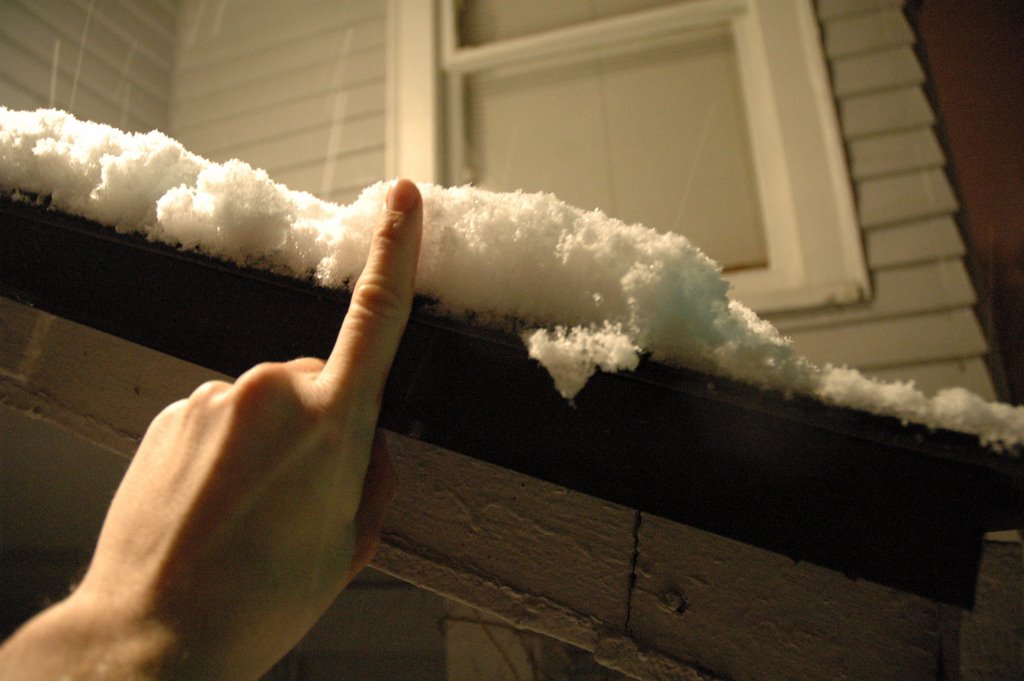
however, my parents dial-up connection prohibited me from any kind of work on the blog-front. and then, upon arriving home, i discovered a strange white powder covering the ground outside my house. after deliberating with my roommate, i decided that the mysterious white required further attention. so, as usual, i'm not going to say much of anything tonight. still, perhaps i'll be back soon. perhaps the snow will shutdown the city, and on monday i'll have nothing to do but blog.

andrew david "2.2 inches, under my window" seattle, washington.
mark tomato "abnormally clad snow dancers" seattle, washington.

Saturday, October 22, 2005

a. the dilemma (of how to get from a to z, that is, of what to do in life and of how to pare that vocation down to the simplest possible terms)

b. THE PRESENT
c. andrew likes to write in books.

d. he likes to analyze what he reads in terms of content. he especially likes works with brooding protagonists or characters that are forced to confront the crazy wildness within. if books have a theological bent (rather than religious bent), andrew likes that too.

e. he likes to analyze how authors approach the craft of writing. he especially likes books that approach their subject matter with unobtrusive personal metaphors. in this sense, he likes writing that is poetic. if books swap poetry for the colloquial voice of a particular time & place (like say 'the poisonwood bible,' 'the catcher in the rye,' or anything by william faulkner), andrew thinks it brazen and lame. perhaps this makes him a bit of an odd language snob.

f. in a related fashion, andrew likes to edit. he likes to tear apart sentences, paragraphs, and manuscripts. perhaps this curious delight represents an attempt by andrew to press his aesthetic ideals on others. in any case, andrew thinks that he has a good ear for language. plus, he likes grammar.

g. andrew may like to write. he's not sure. but once its written, he certainly likes to edit it.

h. andrew likes to learn. traditionally, he has both enjoyed school and done very well.

i. THE FAR FUTURE
j. andrew could see himself enjoying the following careers: teacher and editor.

k. as a teacher, andrew would enjoy helping students illuminate life-changing texts. however, he's not entirely confident that he would measure up to the standards of insight required of collegiate professors. he wonders whether he could pull enough thoughtful content from a work to spark discussion or merit classroom respect. moreoever, andrew believes that books are important, but feels like a bit of a stoic when it comes to his response to books. like other 'deep' things in his life, andrew sometimes feels a static admiration for the sublime meaningfulness of a passage but never experiences the actual passionate response. again, andrew questions whether this might be an obstacle for enlightening students.

l. perhaps andrew's favorite part of teaching might be the opportunity to impact student writing. during his time at the spu writing center and in freelance editing,andrew encountered a lot of potentially good writing that was just plain crappy. with a tweeking, these writers could be fine. andrew thinks he would enjoy editing student papers and working with students to improve.

m. but andrew would not like playing the role of baby-sitter. he might have difficulty contending with students that lack interest in his class.

n. if andrew wound up teaching at a high school, he would want a piano in his classroom.

o. as an editor, andrew wouldn't have to put up with apathetic students. on the otherhand, he might also miss the hands-on nature of the editing that he has hitherto experienced. this could be difficult. moreover, it might take a bit of work before he reached a position where he was editing material that he found personally significant. and once he reached a position where he was editing material he really enjoyed, would he get bored of it?

p. THE NEAR FUTURE
q. to be a teacher, andrew would need to pursue a masters or phd (or both).

r. why andrew is worried about this:
http://gradschool.about.com/gi/dynamic/offsite.htm?site=http%3A%2F%2Fwww.upenn.edu%2Fcareerservices%2Fgradprof%2Fgrad%2Fgradenglish.html
http://gradschool.about.com/gi/dynamic/offsite.htm?site=http%3A%2F%2Fwww.cas.suffolk.edu%2Fenglish%2FGRADSHOP.HTM

s. so, we see that the road to a degree (800 pgs of reading a week) and job prospects for wanna-be english profs are tough.

t. andrew is also worried by the competively esoteric nature of grad school. this may be because he feels unprepared for the intense submersion into critical theory that may await him. andrew once claimed that there are no geniuses. while this claim was 90% silliness, he actually had a tablespoon or two of belief invested in it. now, he is surprised to find himself INTIMIDATED by the cerebral giants that lay in the shadows of grad school.

u. ack! andrew feels so stinkin rushed. if he pursues his initial plan of fall 2006 enrollment, he would have to study for the lit gre (where he needs a kick-butt score in order to overcome his less-than-amazing ordinary gre score), decide on schools and programs (that is, find attractive programs that can be reasonably expected to say 'come on over drew'), prepare forms for professor recommendations, find an insightful writing sample that is drenched in literary theory, prepare applications, and compose a heart-wrenching personal statement -- all in about a month!!!

v. ALTERNATIVE PLAN
w. finish work at the va in august 2006

x. during the intervening months thoroughly explore my employment options in the editing field. sign on with a publishing company or speciality journal. if nothing else, volunteer for beth's tutoring program.

y. and spend the next 12 months studying for the gres, perfecting a personal statement, scouring grad school programs for that perfect match, and then applying early.